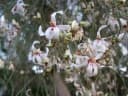
Moringa peregrina
Moringa peregrina
Safety & Hazards
None known
Cultivation Details
A plant of the arid tropics. Young seedlings have broad leaflets and form a large tuber. The plant will often only produce herbaceous growth when young, especially in dry years, dying back to ground level in the dry season. Once the tuber is large enough, the growth above ground will become woody and persist[1]. The first fruits are produced about 3 years after planting[1]. The plant grows quickly from both seeds and cuttings; 3 - 4 metres of annual increase in height is not unusual when adequate moisture is available[1]. Pollarding or pruning following harvesting is recommended to promote branching. This increases pod production and facilitates harvesting as the tree is kept at a manageable height[1]. A single tree may produce up to 1,000 seedpods per year[1].
Propagation
Seed - best sown in a nursery seedbed in light shade[1]. Transplanting 5-month-old seedlings gave good survival rates[1]. Cuttings - branches 100 - 150cm long have been used as cuttings and these have performed well[1]. Cite as: Tropical Plants Database, Ken Fern. tropical.theferns.info. 2026-02-20. <tropical.theferns.info/viewtropical.php?id=Moringa+peregrina>
Pollinators
Bees
References
- [1]Protabase - Plant Resources of Tropical Africa. — http://www.prota.org ↩︎An excellent on-line database with detailed information on over 3,200 species of useful plants of Africa.
- [2]Moringa hildebrandtii (Moringaceae): a tree extinct in the wild but preserved by indigenous horticultural practices — Olson M.E. & Razafimandimbison S.G. · Museum National d'Histoire Naturelle; Paris. · 2000 ↩︎A very interesting article about the cultivation of Moringa hildebrandtii, giving some information on plant uses.