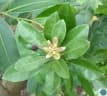
Morella esculenta
Morella esculenta
Safety & Hazards
None known
Cultivation Details
Succeeds in tropical and subtropical climates, being found at elevations from the lowland up to 2,100 metres[1]. It is only likely to succeed outside in the very mildest areas of the temperate zone. Prefers a dry, well-drained soil, and can be found on sandy dunes and stony laterites[1]. Prefers a moist soil. Grows well in an open position in a well-drained soil in sun or light shade[2]. Thrives in any ordinary garden soil. Prefers a lime-free loamy or peaty soil[3]. Yields from mature trees can be as high as 25kg per year, but are more often around 15.5kg[4, 1]. They have a long season of fruiting, which is ideal for home use but difficult if the fruit is to be grown commercially. A dioecious species, both male and female forms need to be grown if fruit and seed are required[5]. Plants in this genus are notably resistant to honey fungus[2]. Many species in this genus have a symbiotic relationship with certain soil micro-organisms, these form nodules on the roots of the plants and fix atmospheric nitrogen. Some of this nitrogen is utilized by the growing plant but some can also be used by other plants growing nearby[2].
Propagation
Seed - best sown as soon as it is ripe in the autumn in a cold frame. Barely cover the seed and keep it moist. Stored seed germinates more freely if given a 3 month cold stratification and then sown in a cold frame. Germination is usually good[6]. Prick out the seedlings into individual pots when they are large enough to handle and grow on in the cold frame for the first winter. Plant out in late spring or early summer[PFAF]. Cuttings of half-ripe wood, 5 - 8cm with a heel, mid summer in a frame. Pot up and overwinter in a cold frame. Fair to good percentage[6]. Cuttings of mature wood in late autumn in a frame. Layering in spring[2]. Division of suckers in the dormant season. Plant them out direct into their permanent positions. Cite as: Temperate Plants Database, Ken Fern. temperate.theferns.info. 2026-02-21. <temperate.theferns.info/plant/Morella+esculenta>
Pollinators
Wind
References
- [1]Plant Resources of Southeast Asia — http://proseanet.org/ ↩︎Lots of information on the uses of the plants of SE Asia.
- [2]The New RHS Dictionary of Gardening. 1992. — Huxley. A. · MacMillan Press · 1992 · ISBN 0-333-47494-5 ↩︎Excellent and very comprehensive, though it contains a number of silly mistakes. Readable yet also very detailed.
- [3]RHS Dictionary of Plants plus Supplement. 1956 — F. Chittendon. · Oxford University Press · 1951 · ISBN - ↩︎Comprehensive listing of species and how to grow them. Somewhat outdated, it has been replaced in 1992 by a new dictionary (see [ 200 ]).
- [4]Wild Fruits of the Sub-Himalayan Region. — Parmar. C. and Kaushal. M.K. · Kalyani Publishers. New Delhi. · 1982 · ISBN - ↩︎Contains lots of information on about 25 species of fruit-bearing plants of the Himalayas, not all of them suitable for cool temperate zones.
- [5]Flora of China — Missouri Botanical Garden Press; St. Louis. · 1994 · http://flora.huh.harvard.edu/china/ ↩︎An excellent, comprehensive resource in 25 volumes. In addition to the botanical information the flora also gives basic information on habitat and some uses. An on-line version is also available.
- [6]Propagation of Trees, Shrubs and Conifers. — Sheat. W. G. · MacMillan and Co · 1948 · ISBN - ↩︎A bit dated but a good book on propagation techniques with specific details for a wide range of plants.
- [7]Flora Malesiana Series 1 — Various · Nationaal Herbarium Nederiand, Universiteit Leiden branch · http://www.archive.org ↩︎A massive treatment of the plants of the Malaysian Archipelago. Much of it has been made available to download from the Internet
- [8]Plants and People of Nepal — Manandhar. N. P. · Timber Press. Oregon. · 2002 · ISBN 0-88192-527-6 ↩︎Excellent book, covering over 1,500 species of useful plants from Nepal together with information on the geography and peoples of Nepal. Good descriptions of the plants with terse notes on their uses.
- [9]Sturtevant's Edible Plants of the World. — Hedrick. U. P. · Dover Publications · 1972 · ISBN 0-486-20459-6 ↩︎Lots of entries, quite a lot of information in most entries and references.
- [10]Wild Food Plants of Australia. — Low. T. · Angus and Robertson. · 1989 · ISBN 0-207-14383-8 ↩︎Well presented, clear information and good photographs. An interesting read for the casual reader as well as the enthusiast
- [11]A Manual of Indian Timbers. — Gamble. J. S. · Bishen Singh Mahendra Pal Singh · 1972 · ISBN - ↩︎First written in the 19th century, but still a classic, giving a lot of information on the uses and habitats of Indian trees. Not for the casual reader.
- [12]Forest Flora of Chakrata, Dehra Dun and Saharanpur. — Gupta. B. L. · Forest Research Institute Press · 1945 · ISBN - ↩︎A good flora for the middle Himalayan forests, sparsly illustrated. Not really for the casual reader.
- [13]Glossary of Indian Medicinal Plants (Including the Supplement). — Chopra. R. N., Nayar. S. L. and Chopra. I. C. · Council of Scientific and Industrial Research, New Delhi. · 1986 · ISBN - ↩︎Very terse details of medicinal uses of plants with a wide range of references and details of research into the plants chemistry. Not for the casual reader.
- [PFAF]Plants for a Future — pfaf.org ↩︎