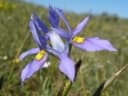
Moraea fugax
Moraea fugax
Safety & Hazards
None known
Cultivation Details
Moraea fugax is a plant of subtropical regions and is not very cold-hardy. It can tolerate short periods with temperatures falling as low as -5°c[1] Requires a light gritty well-drained soil and a sunny position[2, 3, 1]. The bulbs must be kept dry whilst they are dormant[3, 1]. The corms should be planted about 12cm deep. Individual flowers only live for 6 hours, though the plant produces a succession of blooms during the flowering period[2].
Propagation
Seed - best sown as soon as it is ripe in a warm greenhouse. A spring sowing in the greenhouse has proved very successful with us[PFAF]. Sow the seed thinly so that the young plants can be grown on in the pot without disturbance for their first year. Give an occasional liquid feed to ensure that the plants do not become nutrient deficient. Pot up the small bulbs at the end of their first growing season, placing 2 - 3 bulbs in each pot. Grow them on in the greenhouse for another 2 years before planting them out into their permanent positions when they are dormant in the autumn. Division of offsets whilst the plants are dormant from September to January. The larger bulbs can be replanted immediately into their permanent positions, but it is best to pot up the smaller bulbs and grow them on for a year before planting them out in the autumn. Cite as: Temperate Plants Database, Ken Fern. temperate.theferns.info. 2026-02-21. <temperate.theferns.info/plant/Moraea+fugax>
Pollinators
Insects
References
- [1]The New RHS Dictionary of Gardening. 1992. — Huxley. A. · MacMillan Press · 1992 · ISBN 0-333-47494-5 ↩︎Excellent and very comprehensive, though it contains a number of silly mistakes. Readable yet also very detailed.
- [2]Hardy Bulbs.; Including Half-hardy Bulbs and Tuberous and Fiberous-rooted Plants — Grey. C. H. · Williams & Norgate. · 1938 · ISBN - ↩︎Rather dated now, but an immense work on bulbs for temperate zones and how to grow them. Three large volumes.
- [3]The World of Iridaceae — Innes. C. ↩︎Deals with many of the plants in the Iris family giving brief details of habitat and notes on cultivation. Well illustrated.
- [4]Flora of the Cape Peninsula. — Adamson. and Salter. ↩︎A good flora but rather short on details of habitat. Not for the casual reader.
- [5]The Color Encyclopedia of Cape Bulbs — Manning. J. Goldblatt. P. & Snijman. D. · Timber Press, Oregon. · 2002 · ISBN 0-88192-547-0 ↩︎Excellent treatment of these plants, with good descriptions, habitat etc. Lots of high quality colour photographs.
- [6]Tanaka's Cyclopedia of Edible Plants of the World. — Tanaka. T. & Nakao S. · Keigaku Publishing; Tokyo · 1976 · ISBN - ↩︎The most comprehensive list of edible plants I've come across. Only the briefest entry for each species, though, and some of the entries are more than a little dubious. Not for the casual reader.
- [7]Sturtevant's Edible Plants of the World. — Hedrick. U. P. · Dover Publications · 1972 · ISBN 0-486-20459-6 ↩︎Lots of entries, quite a lot of information in most entries and references.
- [8]Cornucopia - A Source Book of Edible Plants. — Facciola. S. · Kampong Publications · 1990 · ISBN 0-9628087-0-9 ↩︎Excellent. Contains a very wide range of conventional and unconventional food plants (including tropical) and where they can be obtained (mainly N. American nurseries but also research institutes and a lot of other nurseries from around the world.
- [PFAF]Plants for a Future — pfaf.org ↩︎