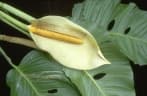
Monstera adansonii
Monstera adansonii
Safety & Hazards
The plant contains calcium oxalate crystals. This substance is toxic fresh and, if eaten, makes the mouth, tongue and throat feel as if hundreds of small needles are digging in to them. However, calcium oxalate is easily broken down either by thoroughly cooking the plant or by fully drying it and, in either of these states, it is safe to eat the plant. People with a tendency to rheumatism, arthritis, gout, kidney stones and hyperacidity should take especial caution if including this plant in their diet[1].
Cultivation Details
A plant of the lowland tropics, moist through the growing season, drier in the cool season[2]. Plants are surprisingly able to withstand light frosts with only slight damage to the leaves[2, 3]. Succeeds in the dappled shade of the woodland[2]. The plant forms two types of aerial roots from the nodes and internodes of the stems - one type grows down to the ground where it roots and is a source of moisture and nutrients, the other type is an anchor root, growing around the stem of the host plant[3]. A very variable species, at times it has been subdivided into several different species though it has now been shown that these can all intergrade into each other[3].
Propagation
Seed - Cite as: Tropical Plants Database, Ken Fern. tropical.theferns.info. 2026-02-20. <tropical.theferns.info/viewtropical.php?id=Monstera+adansonii>
Pollinators
Bees, Insects
References
- [1]Encyclopaedia of Herbs and their Uses. — Bown. D. · Dorling Kindersley, London. · 1995 · ISBN 0-7513-020-31 ↩︎A very well presented and informative book on herbs from around the globe. Plenty in it for both the casual reader and the serious student. Just one main quibble is the silly way of having two separate entries for each plant.
- [2]Tropical Flowering Plants. A Guide to Identification and Cultivation. — Llamas K.A. · Timber Press; Oregon. · 2003 · ISBN 0-88192-585-3 ↩︎A terse guide for the gardener to almost 1,500 species of ornamental tropical plants with brief details on their cultivation and, usually, a small photograph of good quality.
- [3]Contributions from the Gray Herbarium Vol. 207 — Harvard University; Massachusets · 1977 · http://www.biodiversitylibrary.org ↩︎A botanical journal, it contains a revision of the genus Monstera. It can be downloaded from the Internet.
- [4]Useful Plants of the Siona and Secoya Indians of Eastern Ecuador. — Vickers W.T.; Plowman T. · Field Museum of Natural History; USA. · 1984 · http://www.biodiversitylibrary.org · ISBN 0015 - 0746 ↩︎Very terse, but it gives the uses of a large number of species. It can be downloaded from the Internet.
- [5]Medicinal Plants of the Guianas — DeFilipps, R. A.; Maina, S. L.; & Crepin, J. · Smithsonian Museum · http://botany.si.edu/bdg/medicinal/index.html ↩︎A down-loadable PDF document of a book in pre-publication awaiting illustration. An excellent, if rather terse, guide to the traditional medicinal uses of the plants of the region