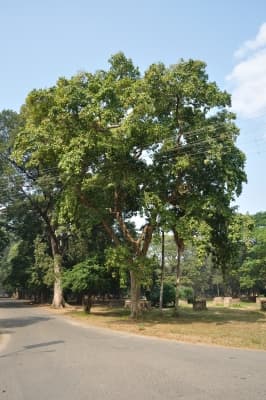
Mitragyna parvifolia
Mitragyna parvifolia
Safety & Hazards
None known
Cultivation Details
A plant of the tropics, where it is found at elevations up to 1,300 metres. It grows best in areas where annual daytime temperatures are within the range 20 - 35°c, but can tolerate 5 - 47°c[1]. When dormant, the plant can survive temperatures down to about -5°c, but young growth can be severely damaged at -1°c[1]. It prefers a mean annual rainfall in the range 1,500 - 2,500mm, but tolerates 900 - 3,300mm[1]. Young trees withstand shade, whilst older trees are light demanding[1]. Succeeds in wide range of fertile soils[1]. Prefers a pH in the range 5.5 - 6.5, tolerating 4.5 - 7.5[1]. The tree reproduces very sparingly in the wild, but better where the soil has been broken up so that the small seeds can reach the ground without difficulty[2]. The flowers are very fragrant[3].
Propagation
Seed. The plant is difficult to propagate in the nursery[2]. Cite as: Tropical Plants Database, Ken Fern. tropical.theferns.info. 2026-02-20. <tropical.theferns.info/viewtropical.php?id=Mitragyna+parvifolia>
Pollinators
Data unavailable
References
- [1]Ecocrop — http://ecocrop.fao.org/ecocrop/srv/en/home ↩︎Basic information on a wide range of useful plants, plus details of environmental needs where available.
- [2]A Manual of Indian Timbers. — Gamble. J. S. · Bishen Singh Mahendra Pal Singh · 1972 · ISBN - ↩︎First written in the 19th century, but still a classic, giving a lot of information on the uses and habitats of Indian trees. Not for the casual reader.
- [3]Flowers of India — http://www.flowersofindia.net/ ↩︎A wed site of native Indian plants, plus cultivated and naturalized species. It has good quality photos and terse details on more than 3,000 species and cultivars.
- [4]Glossary of Indian Medicinal Plants (Including the Supplement). — Chopra. R. N., Nayar. S. L. and Chopra. I. C. · Council of Scientific and Industrial Research, New Delhi. · 1986 · ISBN - ↩︎Very terse details of medicinal uses of plants with a wide range of references and details of research into the plants chemistry. Not for the casual reader.