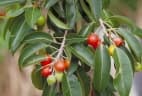
Mimusops elengi
Mimusops elengi
Safety & Hazards
The sawdust is irritating to nose and throat[1].
Cultivation Details
A plant of the hot tropical lowlands[2]. It thrives in areas with perhumid or slightly seasonal rainfall types, but is most commonly found in seasonally dry habitats[1]. It is tolerant of light frosts[1]. The tree grows best in a sunny position[3, 4], but is shade tolerant, retaining a full crown and reproducing satisfactorily under fairly dense shade[1]. It prefers a deep, rich loam[3, 1, 4], but plants are adapted to a variety of soils[2]. Fairly wind tolerant, trees can be grown in coastal sites[1]. It can tolerate inundation of the soil for up to 2 months[1]. Seedlings and trees grow slowly, but occasionally trees may reach a height of 34 metres in 20 years, with a bole diameter of 50cm[1]. Trees may flower and fruit throughout the year. Infrequent visits of insects and bats have been observed, but pollination is most likely by wind. The stigma is receptive before the pollen is released, stimulating cross-pollination[1]. Trees may differ markedly in size depending on their origin, which offers potential for selection and possibly breeding activities[1].
Propagation
Seed - best sown in individul containers in a shaded position, it usually germinates within 17 - 82 days, with a success rate of about 70 - 90%. Seedlings can be planted out when 20 - 30cm tall[1]. Seed can be stored for about 9 months and needs ‘after-ripening’ during the first month of storage[1]. Greenwood cuttings. The rooting success of 10 - 15cm long cuttings with a diameter of 5 - 10mm is 70 - 90%[1]. Air layering. Grafting. Cite as: Tropical Plants Database, Ken Fern. tropical.theferns.info. 2026-02-20. <tropical.theferns.info/viewtropical.php?id=Mimusops+elengi>
Pollinators
Wind
References
- [1]Protabase - Plant Resources of Tropical Africa. — http://www.prota.org ↩︎An excellent on-line database with detailed information on over 3,200 species of useful plants of Africa.
- [2]Perennial Edible Fruits of the Tropics : an Inventory — Martin, F. W.; Campbell, C. W.; Rubertbe, R. M. · U.S. Dept. of Agriculture, Agricultural Research Service · 1987 ↩︎A booklet giving terse details of almost 300 species of edible fruits, plus regional lists of Botanical and Common names for over 2,500 less well-known edible fruits of the tropics.
- [3]The New RHS Dictionary of Gardening. 1992. — Huxley. A. · MacMillan Press · 1992 · ISBN 0-333-47494-5 ↩︎Excellent and very comprehensive, though it contains a number of silly mistakes. Readable yet also very detailed.
- [4]Tropical and Subtropical Trees - A Worldwide Encyclopaedic Guide. — Barwick. M. · Thames & Hudson, London · 2004 · ISBN 0-500-51181-0 ↩︎A superb book, very concise and well written, giving a wealth of information on 400 or more species including descriptions, habitat, cultivation details and plant uses. A wealth of colour photographs bring each plant vividly to life.
- [5]Trade in Indian Medicinal Plants — D.K.Ved, S.Noorunnisa Begum, & K.Ravi Kumar · Apple Academic Press; Oakville, Canada · 2018 · ISBN 978-1-77188-600-0 ↩︎
- [6]Flora of Pakistan — http://www.efloras.org ↩︎As of 2006, there is not much information on habitats available, but it is being developed and promises to be an excellent resource.
- [7]Mansfeld's Database of Agricultural and Horticultural Plants — http://mansfeld.ipk-gatersleben.de/pls/htmldb_pgrc/f?p=185:3:4292127278597336 ↩︎Terse details of a huge range of useful plants.
- [8]Cornucopia II — Facciola. S. · Kampong Publications, California. · 1998 · ISBN 0-9628087-2-5 ↩︎The second edition of an excellent guide to the edible uses of plants, though it does not give any details of cultivation etc.