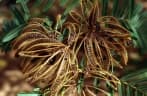
Mimosa pigra
Mimosa pigra
Safety & Hazards
None known
Cultivation Details
The plant grows in areas of the lowland tropics where there is a distinct dry season[1]. It is usually found at elevations from near sea level to 700 metres, occasionally to 1,000 metres[1, 2]. It grows best in areas where annual daytime temperatures are within the range 15 - 30°c, but can tolerate 8 - 38°c[2]. When dormant, the plant can survive temperatures down to about °c, but young growth is more tender and can be severely damaged at °c[2]. It prefers a mean annual rainfall in the range 800 - 1,500mm, but tolerates 500 - 2,00mm[2]. Requires a sunny position[2]. Found most commonly in the wild in soils ranging from black cracking clays to sandy clays to coarse siliceous river sand[3]. Prefers a pH in the range 5.5 - 7, tolerating 5 - 7.5[2]. Plants are tolerant of drought, and also of seasonal inundation of the soil[2]. In its native range, the plant is kept in check by insect and fungal pathogens. However, these natural controls are absent in other countries and, after it was introduced to the Australian Darwin Botanic Gardens in the late 1800s it escaped into the wild[1]. Since the late 1970's, this plant has become a serious weed of pastureland and national parks in northern Australia[1]. It has several characteristics that enable it to do well in open disturbed sites: it grows quickly, it can withstand drought and floods, and the seeds float. It threatens biological diversity by replacing wetlands with an impenetrable thorny thicket. It is also detrimental to pastoralism, tourism and traditional use of land by Aboriginal people[1]. The plant presents a very different picture in its native range, where its natural habitat is mainly marginal areas of canals, rivers and lakes, and this gives some hope to researchers looking for biological controls[1]. In Mexico, for example, it is a rather obscure weed[1]. It would probably not be a major weed problem in regions with an annual rainfall of less than 750 mm or greater than 2,250 mm, except in cases of clear cutting[1]. Seeds of this prickly shrub spread through river systems by floating downstream[1]. They are also carried between river systems by animals, or in mud on vehicles[1]. Mature plants are resistant to fire, the majority of plants regrowing from the base of stems[1]. Young plants are more susceptible, but a large proportion also regrow[1]. Mimosa infestations can expand very rapidly, so it is important to prevent the spread to new areas, as well as to control existing infestations[1]. Current control methods are costly and require lengthy ongoing commitment[1]. This species has a symbiotic relationship with certain soil bacteria, these bacteria form nodules on the roots and fix atmospheric nitrogen. Some of this nitrogen is utilized by the growing plant but some can also be used by other plants growing nearby[4].
Propagation
Seed - mature seed requires pre-treatment in order to break down the hard seed coat and allow the ingress of water[1]. This can be done in various ways, including abrading the seed coat (being careful not to damage the embryo); immersing the seed in a small quantity of almost boiling water (which cools fairly quickly and so does not cook the seed) and then soaking the seed for 12 - 24 hours in warm water; the seeds also germinate profusely if they are subject to burning - though obvious care is required to ensure the heat is not too great and cooks the seed[1]. Germination rates of 98% have been achieved from treated seed[1]. Cite as: Tropical Plants Database, Ken Fern. tropical.theferns.info. 2026-02-20. <tropical.theferns.info/viewtropical.php?id=Mimosa+pigra>
Pollinators
Insects
References
- [1]World Agroforesty Centre — http://www.worldagroforestry.org/ ↩︎An excellent online database of a huge range of trees giving very good information on each plant - its uses, ecology, identity, propagation, pests etc.
- [2]Ecocrop — http://ecocrop.fao.org/ecocrop/srv/en/home ↩︎Basic information on a wide range of useful plants, plus details of environmental needs where available.
- [3]Global Invasive Species Database — http://www.issg.org/database/welcome/ ↩︎Very detailed information on almost 400 species (with more being added) of plants that have become weeds in areas outside their native range.
- [4]Nodulation Plants in GRIN Taxonomy — United States Department of Agriculture · http://www.ars-grin.gov/~sbmljw/cgi-bin/taxnodul.pl?language=en ↩︎An online database listing plants that have either positive or negative reports on root and stem nodulation with nitrogen-fixing bacteria.
- [5]Trees and Shrubs of the Sahel. Their Characteristics and Uses. — von Maydell H. · Deutsche Gesellschaft fur Technische Zusammenarbeit; Germany · 1990 · ISBN 3-8236-1198-4 ↩︎A well-researched book, usually with more than one photograph of each species and good information on the plant and its uses.
- [6]Medicinal Plants of the Guianas — DeFilipps, R. A.; Maina, S. L.; & Crepin, J. · Smithsonian Museum · http://botany.si.edu/bdg/medicinal/index.html ↩︎A down-loadable PDF document of a book in pre-publication awaiting illustration. An excellent, if rather terse, guide to the traditional medicinal uses of the plants of the region