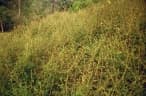
Mimosa diplotricha
Mimosa diplotricha
Safety & Hazards
None known
Cultivation Details
Mimosa diplotricha is a plant of the moister tropics, where it can be found at elevations up to 2,000 metres[1]. Although it prefers light, permeable soils, it can also be grown on heavy clay soils[1]. The plant may die during prolonged dry spells[1]. The spiny form of this species has been declared a noxious weed in many areas of the tropics[1, 2]. Seedpods of the spiny forms have spiny surfaces and are easily distributed by animals and farm machinery[1]. The plant has a robust habit of growth, scrambling over other plants forming spreading, tangled masses or thickets of undergrowth up to 2 metres tall, eventually forming pure stands[1]. The plant can flower and fruit all year round[1]. The species has been subdivided into three varieties:- Var. Inermis (Adelb.) Veldkamp. This is a spineless form that originated in Java. It is still cultivated. It is an excellent soil improver, cover crop and soil binder against erosion in humid areas, but is somewhat less effective in smothering weeds than the spiny form[1, 2]. Var. Diplotricha. A spiny form, it is distributed all over tropical America and has spread pantropically as a weed. This form used to be cultivated as a green manure, fallow crop and cover crop. However, it is now considered a noxious weed because it aggressively colonizes open spaces, produces large amounts of easily distributed seed and may pose a fire hazard. Because of its spines, it is especially notorious in hand-harvested sugar cane[1, 2]. Var. Odibilis Barneby. A spiny form that is only known from Mexico[2]. This species has a symbiotic relationship with certain soil bacteria, these bacteria form nodules on the roots and fix atmospheric nitrogen. Some of this nitrogen is utilized by the growing plant but some can also be used by other plants growing nearby[3].
Propagation
Seed - germinates best if pre-treated by immersing the seed in hot water at 98°c for 90 seconds, or in 98% sulphuric acid for 20 - 30 minutes[1]. Dry heat has also given a high germination rate[1]. The seed is sown in situ[1]. Untreated seed may germinate immediately or remain dormant in the soil for a long period[1]. Seed collected about 50 days after flowering gives the highest direct germination rate[1]. Cite as: Tropical Plants Database, Ken Fern. tropical.theferns.info. 2026-02-20. <tropical.theferns.info/viewtropical.php?id=Mimosa+diplotricha>
Pollinators
Bees
References
- [1]Plant Resources of Southeast Asia — http://proseanet.org/ ↩︎Lots of information on the uses of the plants of SE Asia.
- [2]Mansfeld's Database of Agricultural and Horticultural Plants — http://mansfeld.ipk-gatersleben.de/pls/htmldb_pgrc/f?p=185:3:4292127278597336 ↩︎Terse details of a huge range of useful plants.
- [3]Nodulation Plants in GRIN Taxonomy — United States Department of Agriculture · http://www.ars-grin.gov/~sbmljw/cgi-bin/taxnodul.pl?language=en ↩︎An online database listing plants that have either positive or negative reports on root and stem nodulation with nitrogen-fixing bacteria.