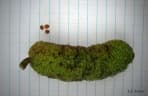
Milicia excelsa
Milicia excelsa
Safety & Hazards
The wood and sawdust may cause dermatitis, irritation to nose and throat, and asthmatic reactions, due to the presence of the phenol chlorophorin[1].
Cultivation Details
A tree of moist to wet tropical forests at low to medium elevations from sea level to 1,600 metres[2]. It occurs in regions with an average annual temperature of 25 - 35°c and an average annual rainfall of 1,150 - 1,900mm[1]. The tree can tolerate a dry season of up to 6 months and can grow in areas with mean annual rainfall as low as 700mm provided it has access to extra water from a perennial stream or underground source[3]. African teak succeeds on a large variety of soils so long as they are fertile, it is especially sensitive to low levels of potassium and phosphorus[1]. Its presence is considered to be an indicator of fertile soil suitable for cultivation[1]. It prefers well-drained soils and does not tolerate impeded drainage[1]. It is a pioneer species, demanding intense light and unable to stand deep shade[1]. Young trees grow continuously, but growth of adult trees is periodical[1]. Trees are fairly fast growing - in a 6-year-old plantation some trees were over 6 metres tall, although the variability was large[1]. On average it takes 130 years here for a tree to reach a trunk diameter of 80cm[1]. Male trees can start flowering within 10 years from seed, but females can take 15 years[2]. It takes 5 - 6 weeks from fertilization to fruit maturation. Seed dispersal is mostly by birds, bats and squirrels[1]. Trees respond well to pruning and coppicing[1]. In the dry season Milicia excelsa is deciduous for a short period[1]. Dioecious - both male and female forms need to be grown if seed is required[2].
Propagation
Seed - can be stored at room temperature for at least 12 months[2]. When sown fresh it normally gives good germination rates of 90% or more within 2 - 4 weeks[1]. Seeds are sown in a seedbed and transplanted to pots or nursery beds 3 weeks after germination. Seedlings should be grown under shade to limit attacks by Phytolyma spp[1]. About 4 months after sowing the seedlings are around 30cm tall and ready for planting out in the field[1]. Young plants transplant well[1]. Stem cuttings[1]. Successful propagation has been achieved using stem cuttings from 1- and 2-year-old trees, but from mature trees cuttings should be taken from coppice shoots[1]. Root cuttings[1]. Grafting[1]. Cite as: Tropical Plants Database, Ken Fern. tropical.theferns.info. 2026-02-20. <tropical.theferns.info/viewtropical.php?id=Milicia+excelsa>
Pollinators
Data unavailable
References
- [1]Protabase - Plant Resources of Tropical Africa. — http://www.prota.org ↩︎An excellent on-line database with detailed information on over 3,200 species of useful plants of Africa.
- [2]Seed Leaflets — Various · Forest & Landscape. Denmark · http://en.sl.life.ku.dk/Publikationer/Udgivelser/PopulaerPublikationer.aspx?katid={D28373CC-6EF3-4EF8-B097-6D83FABF209E}&serieid={9F1C3DB1-6E7B-4CF1-AF53-F480B0CB40EF}&sort=title ↩︎A series of leaflets, jointly produced by the University of Copenhagen and the Royal Botanic Gardens at Kew, focussing on seed information for a number species, but also giving a lot of other information about each plant.
- [3]World Agroforesty Centre — http://www.worldagroforestry.org/ ↩︎An excellent online database of a huge range of trees giving very good information on each plant - its uses, ecology, identity, propagation, pests etc.
- [4]IUCN Red List of Threatened Species — http://www.iucnredlist.org/ ↩︎A list of plants under threat and facing possible extinction, usually with brief details of the threats and information on habitat.
- [5]Tropix 7 — CIRAD · http://tropix.cirad.fr/en ↩︎An on-line guide to the timbers of 245 species of trees.