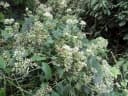
Mikania cordata
Mikania cordata
Safety & Hazards
None known
Cultivation Details
A plant of the moist tropics, where it is found at elevations up to 2,000 metres. It grows best in areas where annual daytime temperatures are within the range 22 - 28°c, but can tolerate 13 - 38°c[1]. It prefers a mean annual rainfall in the range 2,000 - 2,500mm, but tolerates 1,500 - 3,500mm[1]. Grows best in full sun but tolerates light shade[1]. Succeeds in a range of soils of moderate fertility[1]. Prefers a rich, damp soil[2]. Prefers a pH in the range 4.5 - 5.5, tolerating 4 - 7[1]. The plant can become a devastating weed in crops of tea, coconut, rubber, oil palm, coffee, bananas and sugar cane, and can smother leguminous cover crops[1]. It has been reported from Malaysia that the plant contains phenolic or flavonoid substances that inhibit the growth of rubber, tomato and tropical kudzu (Pueraria phaseoloides (Roxb.) Benth.), and also depress nitrification in soils[3]. It requires an open sunny position, however, and although it may even be found under closed canopies of 4 - 5 year-old rubber and oil palm, it is markedly etiolated with little vigour and is rarely found in 5 - 15 year-old plantations[3]. Plants can flower all year round and large amounts of seed are transported by the wind or by adhering to human clothing or the hair of animals[2, 1]. The flowers are strongly fragrant[4].
Propagation
Seed - Cite as: Tropical Plants Database, Ken Fern. tropical.theferns.info. 2026-02-20. <tropical.theferns.info/viewtropical.php?id=Mikania+cordata>
Pollinators
Data unavailable
References
- [1]Ecocrop — http://ecocrop.fao.org/ecocrop/srv/en/home ↩︎Basic information on a wide range of useful plants, plus details of environmental needs where available.
- [2]Pacific Island Ecosystems at Risk — http://www.hear.org/pier/scientificnames/index.html ↩︎A very good website detailing weed species that have been introduced into the Pacific Islands.
- [3]Plant Resources of Southeast Asia — http://proseanet.org/ ↩︎Lots of information on the uses of the plants of SE Asia.
- [4]Flowers of India — http://www.flowersofindia.net/ ↩︎A wed site of native Indian plants, plus cultivated and naturalized species. It has good quality photos and terse details on more than 3,000 species and cultivars.
- [5]Philippine Medicinal Plants — http://www.stuartxchange.org/CompleteList.html ↩︎A lovely site, giving brief details on the medicinal uses of several hundred (over 400 at the last count) plants in the Philippines, plus a picture of each plant.