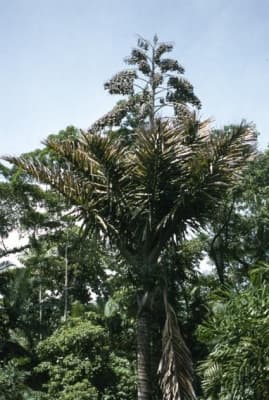
Metroxylon salomonense
Metroxylon salomonense
Safety & Hazards
None known
Cultivation Details
A plant of the humid, tropical, lowland forests, able to succeed at elevations up to 700 metres[1]. It prefers a mean annual rainfall in the range 2,000 - 5,000mm, and does not tolerate more than a short dry period[1]. It prefers a mean annual temperature of around 25°c with a minimum of 17°c. It is not tolerant of frost, though it can succeed in cooler areas of the tropics such as Hawaii, but then grows more slowly[1]. Prefers a relatively sunny position[1]. Succeeds in a wide range of soils, preferring medium to heavy soils with somewhat impeded drainage[1]. It can persist on well drained, poor quality materials including sand, clay, or 'aï' lava[1]. It will grow in soil that is periodically inundated by salt water as long as fresh water flow is more prevalent[1]. Plants are not very tolerant of water shortage, but nor do they like inundation for more than short periods[1]. Succeeds in a wide range of pH, from 4 - 7.4[1]. Plants are tolerant of strong, salt-laden winds[1]. Plants usually take 12 - 15 years to come to flowering maturity from seed, though in ideal conditions this can be reduced to about 10 years[1]. A monocarpic species, they only flower once and then die[1].
Propagation
The seed loses its viability rapidly when stored and does not tolerate dry conditions. It is best sown as soon as it falls from the tree, usually germinating within 1 - 2 months[1]. They germinate best at a temperature of 30°c, though temperatures above 38°c can harm the seeds[1]. Seeds sometimes germinate whilst still attached to the infructescence and can grow to a height of 90 - 120cm before falling to the ground[1]. Germination can be speeded up if the seed husk is removed and the covering over the embryo is loosened. Care should be taken not to damage the embryo[1]. The large seed size and rapid early growth mean this species is well suited for direct-seeding in the field, assuming conditions are consistently moist. Seedlings can also be germinated in a nursery and transplanted bareroot. They transplant well as long as the roots are not bound[1]. Plants should be planted out as soon as possible. Although best planted out whilst fairly small, specimens with several sub-mature leaves 1 - 2 metres long and a well developed root system have been successfully planted out[1]. Cite as: Tropical Plants Database, Ken Fern. tropical.theferns.info. 2026-02-20. <tropical.theferns.info/viewtropical.php?id=Metroxylon+salomonense>
Pollinators
Data unavailable
References
- [1]Traditional Trees of Pacific Islands — Elevitch. Craig. R. (Editor) · Permanent Agriculture Resources, Hawaii · 2006 · ISBN 0970254458 ↩︎Beautifully produced book with superb photos and detailed information on over 50 species of useful plants of the Pacific Islands.
- [2]Ecocrop — http://ecocrop.fao.org/ecocrop/srv/en/home ↩︎Basic information on a wide range of useful plants, plus details of environmental needs where available.
- [PFAF]Plants for a Future — pfaf.org ↩︎