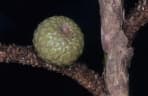
Metroxylon sagu
Metroxylon sagu
Safety & Hazards
None known
Cultivation Details
Sago palm succeeds in wet, lowland tropical climates where it is found at elevations from sea level to 700 metres[1, 2]. It grows best in areas where annual daytime temperatures are within the range 25 - 36°c, but can tolerate 18 - 40°c[3]. When dormant, the plant can survive temperatures down to about 10°c[3]. It prefers a mean annual rainfall in the range 3,000 - 4,500mm, but tolerates 2,100 - 5,800mm[3]. Plants grow well in full sun, even when small[1]. They grow best in clay soils with a high organic-matter content[2]. In the wild, the plant grows on mineral rich soils with a pH of 4.5 or more[2]. Prefers a pH in the range 5.5 - 6.5, tolerating 4.5 - 8.5[3]. Plants can be grown in soils with very high water tables, succeeding even in swamps. They can even tolerate occasional flooding with saline water[3]. Sago palm is hapaxanthic[2]. Each trunk lives for a number of years without flowering but, once it has flowered and fruited, the leaves senesce and the trunk dies completely. However, one or more suckers develop from the base and take over[2]. The vegetative growth phase lasts for at least 8 years before the tree flowers[2]. A single palm may yield about 180 - 350 kilos of sago[3]. It has been calculated that the labour requirement for each kilo of starch obtained from this plant is far less than for any other starch producing plant[1]. There are hermaphroditic and male flowers[2]. The palm can be classified as a nearly complete obligatory cross-breeder, with easy vegetative multiplication[2].
Propagation
Seed - pre-soak for 24 hours in warm water and sow in containers[1]. Germination usually takes several months. The seed germinates only under wet conditions[2]. A rosette grows from the seed, out of which a new bole and new suckers may be formed[2]. Division of suckers[1]. The suckers have the advantage of being readily available and of producing homogeneous offspring, which allows selection of superior forms[2]. Cite as: Tropical Plants Database, Ken Fern. tropical.theferns.info. 2026-02-20. <tropical.theferns.info/viewtropical.php?id=Metroxylon+sagu>
Pollinators
Data unavailable
References
- [1]Palms of the World — Blombery. A. & Rodd. T. · Angus and Robertson · 1992 · ISBN 0-207-14848-1 ↩︎An excellent guide, well illustrated, with information on cultivation, uses, habitat etc of almost 200 species of Palms.
- [2]World Agroforesty Centre — http://www.worldagroforestry.org/ ↩︎An excellent online database of a huge range of trees giving very good information on each plant - its uses, ecology, identity, propagation, pests etc.
- [3]Ecocrop — http://ecocrop.fao.org/ecocrop/srv/en/home ↩︎Basic information on a wide range of useful plants, plus details of environmental needs where available.
- [4]Traditional Trees of Pacific Islands — Elevitch. Craig. R. (Editor) · Permanent Agriculture Resources, Hawaii · 2006 · ISBN 0970254458 ↩︎Beautifully produced book with superb photos and detailed information on over 50 species of useful plants of the Pacific Islands.
- [5]Palm and Cycad Societies of Australia. — http://www.pacsoa.org.au/ ↩︎Contains at least a little information on the majority of palm and cycad species, plus a wealth of photographs. A first class website.
- [6]The New RHS Dictionary of Gardening. 1992. — Huxley. A. · MacMillan Press · 1992 · ISBN 0-333-47494-5 ↩︎Excellent and very comprehensive, though it contains a number of silly mistakes. Readable yet also very detailed.
- [7]Cornucopia II — Facciola. S. · Kampong Publications, California. · 1998 · ISBN 0-9628087-2-5 ↩︎The second edition of an excellent guide to the edible uses of plants, though it does not give any details of cultivation etc.