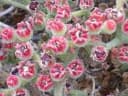
Mesembryanthemum crystallinum
Mesembryanthemum crystallinum
Safety & Hazards
None known
Cultivation Details
Mesembryanthemum crystallinum is not very hardy in the temperate zone and will be killed even by a light frost[1]. It is, therefore, usually grown as a half-hardy annual, being sown in a greenhouse in the spring and used for summer bedding[2]. Easily grown in an ordinary well-drained garden soil[3, 2]. Succeeds in any well-drained low-fertility soil, including saline soils, so long as it is in a sunny position[4, 5]. A very ornamental plant, it is occasionally also cultivated for its edible leaves[3, 1, 6]. This species uses the 'Crassulacean Acid Metabolism' (CAM) pathway to photosynthesis, a mechanism which aids in conserving moisture. The plant keeps its stomata closed during the day, opening them during the night when it takes in carbon dioxide and stores it in compounds such as malic acid. It then utilizes this carbon dioxide when photosynthesizing during the day. This type of mechanism is used by a range of mainly succulent plants, including cacti and Euphorbia species. In climates with mild winters, the plant can flower all year round[6]. Plants have few problems with pests or diseases though the young plants are prone to root rot and damping off unless given plenty of ventilation and dry growing conditions[4].
Propagation
Seed - sow spring in a greenhouse, only just covering the seed. When they are large enough to handle, prick the seedlings out into individual pots and plant them out after the last expected frosts. Seedlings are prone to damp off so should not be over watered and should be kept in a very sunny well-ventilated position[4]. Cite as: Temperate Plants Database, Ken Fern. temperate.theferns.info. 2026-02-21. <temperate.theferns.info/plant/Mesembryanthemum+crystallinum>
Pollinators
Insects
References
- [1]Vegetables — Phillips. R. & Rix. M. · Macmillan Reference Books, London. · 1995 · ISBN 0 333 62640 0 ↩︎Excellent and easily read book with good information and an excellent collection of photos of vegetables from around the world, including many unusual species.
- [2]Salads all the Year Round. — Larkcom. J. · Hamlyn · 1980 ↩︎A good and comprehensive guide to temperate salad plants, with full organic details of cultivation.
- [3]RHS Dictionary of Plants plus Supplement. 1956 — F. Chittendon. · Oxford University Press · 1951 · ISBN - ↩︎Comprehensive listing of species and how to grow them. Somewhat outdated, it has been replaced in 1992 by a new dictionary (see [ 200 ]).
- [4]The New RHS Dictionary of Gardening. 1992. — Huxley. A. · MacMillan Press · 1992 · ISBN 0-333-47494-5 ↩︎Excellent and very comprehensive, though it contains a number of silly mistakes. Readable yet also very detailed.
- [5]Invasive Species Compendium — http://www.cabi.org ↩︎An immense resource - in depth information on over 900 species of invasive plants (it also has information on animals, fungi etc).
- [6]Flora of N. America — http://flora.huh.harvard.edu/fna/ ↩︎An on-line version of the flora with an excellent description of the plant including a brief mention of plant uses.
- [7]Flora Europaea — ? · Cambridge University Press · 1964 · ISBN - ↩︎An immense work in 6 volumes (including the index). The standard reference flora for Europe, it is very terse though and with very little extra information. Not for the casual reader.
- [8]The Vegetable Garden. — Vilmorin. A. · Ten Speed Press · ISBN 0-89815-041-8 ↩︎A reprint of a nineteenth century classic, giving details of vegetable varieties. Not really that informative though.
- [9]A Field Guide to the Common and Interesting Plants of Baja California. — Coyle. J. and Roberts. N. C. · Natural History Publishing Co. · 1975 · ISBN - ↩︎A very readable pocket flora with good illustrations, it gives quite a few plant uses.
- [10]Edible and Useful Wild Plants of the United States and Canada. — Saunders. C. F. · Dover Publications · 1976 · ISBN 0-486-23310-3 ↩︎Useful wild plants of America. A pocket guide.
- [11]Sturtevant's Edible Plants of the World. — Hedrick. U. P. · Dover Publications · 1972 · ISBN 0-486-20459-6 ↩︎Lots of entries, quite a lot of information in most entries and references.
- [12]Cornucopia - A Source Book of Edible Plants. — Facciola. S. · Kampong Publications · 1990 · ISBN 0-9628087-0-9 ↩︎Excellent. Contains a very wide range of conventional and unconventional food plants (including tropical) and where they can be obtained (mainly N. American nurseries but also research institutes and a lot of other nurseries from around the world.
- [13]Antiviral activity of some Tunisian medicinal plants against Herpes simplex virus type 1 — Sassi, A. Ben, Harzallah-Skhiri, F., Bourgougnon, N. and Aou · 2008 · http:// http://dx.doi.org/10.1080/14786410701589790 ↩︎
- [14]The Dictionary of Useful Plants. — Coon. N. · Rodale Press · 1975 · ISBN 0-87857-090-x ↩︎Interesting reading but short on detail.
- [15]Plants for Human Consumption. — Kunkel. G. · Koeltz Scientific Books · 1984 · ISBN 3874292169 ↩︎An excellent book for the dedicated. A comprehensive listing of Latin names with a brief list of edible parts.
- [16]Glossary of Indian Medicinal Plants (Including the Supplement). — Chopra. R. N., Nayar. S. L. and Chopra. I. C. · Council of Scientific and Industrial Research, New Delhi. · 1986 · ISBN - ↩︎Very terse details of medicinal uses of plants with a wide range of references and details of research into the plants chemistry. Not for the casual reader.
- [17]CosIng — http://ec.europa.eu/growth/tools-databases/cosing/ ↩︎CosIng is the European Commission database for information on cosmetic substances and ingredients.
- [PFAF]Plants for a Future — pfaf.org ↩︎