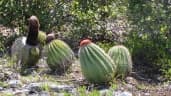
Cactaceae FAMILY Least Concern
Melocactus intortus
Melocactus intortus
Edibility
2/5
Medicinal
0/5
Safety & Hazards
None known
Cultivation Details
HabitEvergreen Shrub
GrowthSlow
Plants can be damaged by temperatures falling below 8°c[1]. Requires a sunny position in a well-drained soil[1]. Prefers a pH below 6[2]. Established plants are very drought tolerant[1]. A slow-growing plant.
Propagation
Seed - Cite as: Tropical Plants Database, Ken Fern. tropical.theferns.info. 2026-02-20. <tropical.theferns.info/viewtropical.php?id=Melocactus+intortus>
Pollinators
Hummingbirds, Insects
References
- [1]Desert Tropicals — http://www.desert-tropicals.com/ ↩︎The main focus of the site is succulent plants, but it also contains information on a wide range of other species. Usually at least one good photograph, plus basic information about the plant and its cultivation.
- [2]The New RHS Dictionary of Gardening. 1992. — Huxley. A. · MacMillan Press · 1992 · ISBN 0-333-47494-5 ↩︎Excellent and very comprehensive, though it contains a number of silly mistakes. Readable yet also very detailed.
- [3]The Cactus Family — Anderson E.F. · Timber Press; Portland, Oregon · 2001 · ISBN 0-88192-498-9 ↩︎An excellent work, giving botanical descriptions of virtually all the cacti, together with their range (but not their habitats) and sometimes also a photo. it also contains a long chapter detailing the many uses of cacti and another on cultivation..
- [4]IUCN Red List of Threatened Species — http://www.iucnredlist.org/ ↩︎A list of plants under threat and facing possible extinction, usually with brief details of the threats and information on habitat.
- [5]Flowering Plants of Jamaica — Adams. C.D. · University of the West Indies; Jamaica. · 1972 ↩︎A terse treatment of the flowering plants of Jamaica, with a botanical description of each plant, notes on habitat etc.
- [6]Cornucopia II — Facciola. S. · Kampong Publications, California. · 1998 · ISBN 0-9628087-2-5 ↩︎The second edition of an excellent guide to the edible uses of plants, though it does not give any details of cultivation etc.
- [7]Food Plants in the Americas: A Survey of the Domesticated, Cultivated, and Wild Plants Used for Human Food in North, — Kermath B.M.; Bennett B.C.' Pulsipher L.M. · 2014 ↩︎A pre-publication draft of an amazing, on-going work first started in 1985. It contains information on more than 3,900 taxa from the Americas - from Arctic regions to the Tropics