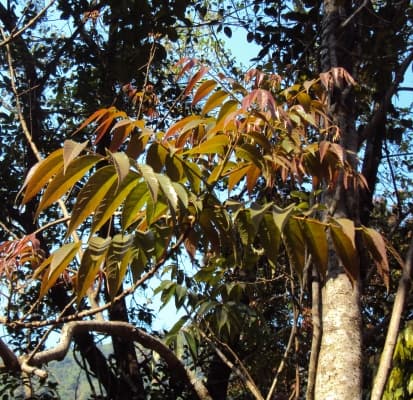
Meliosma pinnata
Meliosma pinnata
Safety & Hazards
None known
Cultivation Details
Meliosma pinnata is a very diverse species and can be found from the warm temperate zone through to the moist tropics at elevations from sea level to around 3,000 metres[1]. The pollen ripens and the anther-cells burst while the flower is still in bud, but the pollen is still unable to escape from the anther-cells as these are locked in the cavities of the staminodes. When the bud is fully mature, it explodes at the slightest touch, the stamens snapping backwards and flinging a puff of pollen into the air. When the flower is open, petals and stamens, having done their duty, very soon drop off; hence in a Meliosma panicle almost only buds and passed flowers are found, but very few intact open flowers[2]. There are various forms of this species with distinct environmental needs[1] - if attempting to grow the plant it would be important to try and obtain it from a provenance as similar as possible to the site where you intend to grow it[PFAF]. Subspecies arnottiana (Wight) Beus. Usually a small to medium tree up to 20 metres, occasionally to 30 metres. Found in primary or secondary montane rain forest at elevations from 600 - 2,500 metres, growing on loamy or volcanic soils, also on limestone if the climate is wet enough. At higher elevations it is deciduous. In Malesia buttresses up to 150cm high are sometimes developed[1]. Subspecies ridleyi (King) Beus. A shrub or a tree, it can grow up to 20 metres tall. Found in primary and secondary rain forest, both in mixed dipterocarp and in heath forest, on various soil types, at elevtions from sea-level up to 1,400 metres[1]. Subspecies ferruginea (Blume) Beus. A medium to large tree, specimens up to 42 metres tall have been reported, with straight, cylindrical boles up to 250cm in diameter. Found in rain forest, preferably on fertile, often volcanic soils, at elevations from 250 - 1,600 metres[1]. Subspecies macrophylla (Merr.) Beus. A medium to large tree, with specimens up to 42 metres tall; the usually straight, cylindrical bole can be 100cm or more in diameter, usually with buttresses 150 - 250cm high. Usually found in primary, rarely in secondary rain forest, at low to medium elevations, occasionally to 1,800 metres. It is generally reported to occur on clayish, loamy, or sandy clayish soils, also on red earth, on volcanic soil, and on loam soil on limestone. It is rarely found in occasionally submerged areas[1]. Subspecies pendula (Merr.) Beus. It can grow up to 20 metres tall. Growing in montane rain forest at elevations from 1,800 - 2,500 metres, it is found in mossy forest, in ravines as well as on exposed ridges[1]. Subspecies sylvatica (Elmer) Beus. A slender shrub or small tree up to 5 metres tall. It is found in the shrub layer of lowland rain forest at elevations below 750 metres[1]. Subspecies humilis (Merr. & Perry) Beus. A small to medium tree up to 20 metres. An understorey tree found in montane rain forests at elevations from 1,000 - 3,000 metres; growing mainly in dense forest on ridges and streambanks, it is also found in more open situations such as such as secondary growth areas and bamboo forest, even occasionally in grassland[1].
Propagation
Seed - Cite as: Tropical Plants Database, Ken Fern. tropical.theferns.info. 2026-02-20. <tropical.theferns.info/viewtropical.php?id=Meliosma+pinnata>
Pollinators
Self
References
- [1]Flora Malesiana Series 1 — Various · Nationaal Herbarium Nederiand, Universiteit Leiden branch · http://www.archive.org ↩︎A massive treatment of the plants of the Malaysian Archipelago. Much of it has been made available to download from the Internet
- [2]Revision of Meliosma (Sabiaceae), section Lorenzanea excepted, Living and Fossil, Geography and Phylogeny — C.F. Van Beusekom · 1971 ↩︎
- [3]Asean Tropical Plant Database — http://211.114.21.20/tropicalplant/index.jsp ↩︎Terse details, with photos, of many of the plants growing in the tropical forests of southeast Asia. Gives some details of plant uses along with a description of the plant and its range.
- [PFAF]Plants for a Future — pfaf.org ↩︎