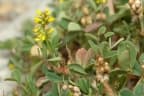
Melilotus indicus
Melilotus indicus
Safety & Hazards
The plant contains coumarin, a substance produced by the plant because it acts as an appetite suppressant and gives some protection from grazing - it is also the compound that gives some dried plants the smell of new mown hay. Coumarin is found naturally in many fruits, including strawberries, black currants, apricots, and cherries; it also has some medicinal applications, though it is also known to be toxic, affecting especially the liver and kidneys. Coumarin is of relatively low toxicity to humans – indeed it has often been used as a flavouring and aromatic additive in foods and other commodities. However, it can be much more toxic to other species, especially rodents and specifically rats. The fresh plant material, consumed in moderation, is generally safe. However, the dried plant material, especially if it is not dried properly and is invaded by fungi, is potentially much more toxic as the coumarin breaks down to form other compounds that can have a strongly anticoagulant effect upon the blood. Warfarin, a well-known anticoagulant drug and rat poison, is one of those compounds produced from coumarin.
Cultivation Details
Melilotus indicus is a plant of the warm temperate zone to the tropics, where it is found at elevations up to 1,650 metres. It grows best in areas where annual daytime temperatures are within the range 15 - 25°c, but can tolerate 4 - 28°c[1]. When dormant, the plant can survive temperatures down to about -2°c, but young growth can be severely damaged at -1°c[1]. It prefers a mean annual rainfall in the range 600 - 900mm, but tolerates 250 - 1,300mm[1]. Prefers a sunny position, but tolerates light shade[1]. Plants can tolerate moderate levels of salt in the soil[1]. Prefers a pH in the range 6.5 - 7, tolerating 5 - 8.5[1]. This species is often cultivated as a fodder crop and cultivars low in coumarin have been developed[2]. This species has a symbiotic relationship with certain soil bacteria, these bacteria form nodules on the roots and fix atmospheric nitrogen. Some of this nitrogen is utilized by the growing plant but some can also be used by other plants growing nearby[3]. When removing plant remains at the end of the growing season, it is best to only remove the aerial parts of the plant, leaving the roots in the ground to decay and release their nitrogen.
Propagation
Seed - sow spring to mid-summer in situ[4]. Pre-soaking the seed for 12 hours in warm water will speed up the germination process, particularly in dry weather[PFAF]. Germination will usually take place within 2 weeks. Cite as: Temperate Plants Database, Ken Fern. temperate.theferns.info. 2026-02-21. <temperate.theferns.info/plant/Melilotus+indicus>
Pollinators
Bees
References
- [1]Ecocrop — http://ecocrop.fao.org/ecocrop/srv/en/home ↩︎Basic information on a wide range of useful plants, plus details of environmental needs where available.
- [2]Medicinal Plants of China — Duke. J. A. and Ayensu. E. S. · Reference Publications, Inc. · 1985 · ISBN 0-917256-20-4 ↩︎Details of over 1,200 medicinal plants of China and brief details of their uses. Often includes an analysis, or at least a list of constituents. Heavy going if you are not into the subject.
- [3]The New RHS Dictionary of Gardening. 1992. — Huxley. A. · MacMillan Press · 1992 · ISBN 0-333-47494-5 ↩︎Excellent and very comprehensive, though it contains a number of silly mistakes. Readable yet also very detailed.
- [4]Green Manures. — Woodward. L. Burge. P. · Elm Farm Research Centre. · 1982 · ISBN - ↩︎Green manure crops for temperate areas. Quite a lot of information on a number of species.
- [5]AgroAtlas — http://www.agroatlas.ru/en/index.html ↩︎An on-line database of economic plants of Russia and the surrounding countries that formed the USSR, giving botanical descriptions, distribution, habitats and uses. It also gives comprehensive information on climate, soil, pests, diseases etc
- [6]Flora of the British Isles. — Clapham, Tutin and Warburg. · Cambridge University Press · 1962 · ISBN - ↩︎A very comprehensive flora, the standard reference book but it has no pictures.
- [7]Flora of China — Missouri Botanical Garden Press; St. Louis. · 1994 · http://flora.huh.harvard.edu/china/ ↩︎An excellent, comprehensive resource in 25 volumes. In addition to the botanical information the flora also gives basic information on habitat and some uses. An on-line version is also available.
- [8]Tanaka's Cyclopedia of Edible Plants of the World. — Tanaka. T. & Nakao S. · Keigaku Publishing; Tokyo · 1976 · ISBN - ↩︎The most comprehensive list of edible plants I've come across. Only the briefest entry for each species, though, and some of the entries are more than a little dubious. Not for the casual reader.
- [9]Glossary of Indian Medicinal Plants (Including the Supplement). — Chopra. R. N., Nayar. S. L. and Chopra. I. C. · Council of Scientific and Industrial Research, New Delhi. · 1986 · ISBN - ↩︎Very terse details of medicinal uses of plants with a wide range of references and details of research into the plants chemistry. Not for the casual reader.
- [10]Native American Ethnobotany — Moerman. D. · Timber Press. Oregon. · 1998 · ISBN 0-88192-453-9 ↩︎Very comprehensive but terse guide to the native uses of plants. Excellent bibliography, fully referenced to each plant, giving a pathway to further information. Not for the casual reader.
- [11]An ethnobotanical survey of medicinal plants used in Loja and Zamora-Chinchipe, Ecuador — Tene V. et al · 2007 · https://doi.org/10.1016/j.jep.2006.10.032 · ISBN 0378-8741 ↩︎
- [PFAF]Plants for a Future — pfaf.org ↩︎