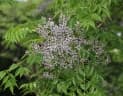
Melia azedarach
Melia azedarach
Safety & Hazards
The fruit is highly toxic to warm-blooded animals[1]. Ripe fruits are more toxic than green ones[2]. As little as six fruits have caused nausea, spasms and fatalities in children[3, 1]. All parts of the plant contain toxins that can cause gastric tract irritation and degeneration of the liver and kidneys[3].
Cultivation Details
Melia azadarach is a tree of the subtropical climatic zone, though it is a highly adaptable plant that can tolerate a wide range of conditions from warm temperate with some frost, right through to the humid tropics[1]. It is grown at elevations up to 1,800 metres in the tropics[1]. It can tolerate a mean maximum temperature in the hottest month of 39°c, with temperatures sometimes falling below freezing for short periods in the cool season[1]. In general, trees will be killed by temperatures falling lower than about -5°c[4]. It can succeed with an annual rainfall as low as 600mm, competing best in areas that receive less than 900mm[1, 5]. Prefers a well-drained soil in a sunny or partially shaded position[6]. Succeeds in most well-drained soils and in hot dry conditions[7]. Likes sandy soils[8]. Tolerant of quite poor growing conditions, including shallow soils, saline and strongly alkaline soils, poor, marginal, sloping, and stony land, even in crevices in sheer rock[1]. It does not like very acid soils[1]. Grows well in mild coastal areas[8]. Established plants are very drought tolerant[1, 9]. Trees can commence flowering when only 5 - 6 years old from seed. In the warmer, non-seasonal areas it can flower and fruit all year round[5]. Trees are fast-growing, but can be quite short-lived, often dying by the time they are 20 years old[10]. The flowers are produced on the current years wood and have a delicate sweet perfume[11, 12]. The trees do not normally require pruning[13]. The seeds have a strong scent of musk and the wood is also musk-scented[12]. Trees are very susceptible to forest fire, though they sprout back readily from the roots[14]. Plants do not coppice well from large stumps, but excellent coppice is obtained from trees up to a girth of 0.9 m. The tree resprouts after cutting and regrows after pollarding, making it suitable for pole production[1]. Plants in this genus are notably resistant to honey fungus[7].
Propagation
Seed - sow late winter in a greenhouse. The seed is best sown as soon as it is ripe in the autumn[8, 15]. The seed usually germinates well. When they are large enough to handle, prick the seedlings out into individual pots and grow them on in the greenhouse for at least their first winter. Plant them out into their permanent positions in late spring or early summer, after the last expected frosts[16]. Root cuttings[17]. Cite as: Temperate Plants Database, Ken Fern. temperate.theferns.info. 2026-02-21. <temperate.theferns.info/plant/Melia+azedarach>
Pollinators
Data unavailable
References
- [1]World Agroforesty Centre — http://www.worldagroforestry.org/ ↩︎An excellent online database of a huge range of trees giving very good information on each plant - its uses, ecology, identity, propagation, pests etc.
- [2]Medicinal Plants of China — Duke. J. A. and Ayensu. E. S. · Reference Publications, Inc. · 1985 · ISBN 0-917256-20-4 ↩︎Details of over 1,200 medicinal plants of China and brief details of their uses. Often includes an analysis, or at least a list of constituents. Heavy going if you are not into the subject.
- [3]Illustrated Flora of North Central Texas — Diggs, Jnr. G.M.; Lipscomb. B. L. & O'Kennon. R. J · Botanical Research Institute, Texas. · 1999 · http://artemis.austincollege.edu/acad/bio/gdiggs/NCTXpdf.htm · ISBN 1-889878-01-4 ↩︎An excellent flora, which is also available on-line.
- [4]Conservatory and Indoor Plants Volumes 1 & 2 — Phillips. R. & Rix. M. · Pan Books, London. · 1998 · ISBN 0-330-37376-5 ↩︎Excellent photos of over 1,100 species and cultivars with habits and cultivation details plus a few plant uses. Many species are too tender for outdoors in Britain though there are many that can be grown outside.
- [5]Seed Leaflets — Various · Forest & Landscape. Denmark · http://en.sl.life.ku.dk/Publikationer/Udgivelser/PopulaerPublikationer.aspx?katid={D28373CC-6EF3-4EF8-B097-6D83FABF209E}&serieid={9F1C3DB1-6E7B-4CF1-AF53-F480B0CB40EF}&sort=title ↩︎A series of leaflets, jointly produced by the University of Copenhagen and the Royal Botanic Gardens at Kew, focussing on seed information for a number species, but also giving a lot of other information about each plant.
- [6]Tropical Ornamentals; A Guide — Whistler. W. Arthur. · Timber Press Inc. Oregon. · 2000 · ISBN 0-88192-448-2 ↩︎An excellent little guide to some of the more commonly cultivated ornamental plants of the Tropics, often giving some information on the plants other uses.
- [7]The New RHS Dictionary of Gardening. 1992. — Huxley. A. · MacMillan Press · 1992 · ISBN 0-333-47494-5 ↩︎Excellent and very comprehensive, though it contains a number of silly mistakes. Readable yet also very detailed.
- [8]The RHS Gardener's Encyclopedia of Plants and Flowers — Brickell. C. · Dorling Kindersley Publishers Ltd. · 1990 · ISBN 0-86318-386-7 ↩︎Excellent range of photographs, some cultivation details but very little information on plant uses.
- [9]Tropical and Subtropical Trees - A Worldwide Encyclopaedic Guide. — Barwick. M. · Thames & Hudson, London · 2004 · ISBN 0-500-51181-0 ↩︎A superb book, very concise and well written, giving a wealth of information on 400 or more species including descriptions, habitat, cultivation details and plant uses. A wealth of colour photographs bring each plant vividly to life.
- [10]Digital Compendium of Forestry Species of Cambodia — www.digitalspecies.blogspot.com; Phnom Penh · 2008 · http://www.digitalspecies.blogspot.com ↩︎A very detailed booklet, produced in PDF format on the internet, giving information on around 100 species of trees.
- [11]Ornamental Shrubs, Climbers and Bamboos. — Thomas. G. S. · Murray · 1992 · ISBN 0-7195-5043-2 ↩︎Contains a wide range of plants with a brief description, mainly of their ornamental value but also usually of cultivation details and varieties.
- [12]Scented Flora of the World. — Genders. R. · Robert Hale. London. · 1994 · ISBN 0-7090-5440-8 ↩︎An excellent, comprehensive book on scented plants giving a few other plant uses and brief cultivation details. There are no illustrations.
- [13]Gardening on Walls — Grey-Wilson. C. & Matthews. V. · Collins · 1983 · ISBN 0-00-219220-0 ↩︎A nice little book about plants for growing against walls and a small section on plants that can grow in walls.
- [14]The Complete Trees of N. America. Field Guide and Natural History. — Elias. T. · Van Nostrand Reinhold Co. · 1980 · ISBN 0442238622 ↩︎A very good concise guide. Gives habitats, good descriptions, maps showing distribution and a few of the uses. It also includes the many shrubs that occasionally reach tree proportions.
- [15]Encyclopaedia of Herbs and their Uses. — Bown. D. · Dorling Kindersley, London. · 1995 · ISBN 0-7513-020-31 ↩︎A very well presented and informative book on herbs from around the globe. Plenty in it for both the casual reader and the serious student. Just one main quibble is the silly way of having two separate entries for each plant.
- [16]Propagation of Trees, Shrubs and Conifers. — Sheat. W. G. · MacMillan and Co · 1948 · ISBN - ↩︎A bit dated but a good book on propagation techniques with specific details for a wide range of plants.
- [17]The Reference Manual of Woody Plant Propagation. — Dirr. M. A. and Heuser. M. W. · Athens Ga. Varsity Press · 1987 · ISBN 0942375009 ↩︎A very detailed book on propagating trees. Not for the casual reader.
- [18]RHS Dictionary of Plants plus Supplement. 1956 — F. Chittendon. · Oxford University Press · 1951 · ISBN - ↩︎Comprehensive listing of species and how to grow them. Somewhat outdated, it has been replaced in 1992 by a new dictionary (see [ 200 ]).
- [19]Australian Medicinal Plants. — Lassak. E. V. and McCarthy. T. · New Holland Publishers · 2001 · ISBN 1876334703 ↩︎A very good and readable guide to the subject.
- [20]Flowers of the Himalayas. — Polunin. O. and Stainton. A. · Oxford Universtiy Press · 1984 · ISBN - ↩︎A very readable and good pocket guide (if you have a very large pocket!) to many of the wild plants in the Himalayas. Gives many examples of plant uses.
- [21]Sturtevant's Edible Plants of the World. — Hedrick. U. P. · Dover Publications · 1972 · ISBN 0-486-20459-6 ↩︎Lots of entries, quite a lot of information in most entries and references.
- [22]Tanaka's Cyclopedia of Edible Plants of the World. — Tanaka. T. & Nakao S. · Keigaku Publishing; Tokyo · 1976 · ISBN - ↩︎The most comprehensive list of edible plants I've come across. Only the briefest entry for each species, though, and some of the entries are more than a little dubious. Not for the casual reader.
- [23]Vegetable Gums and Resins. — Howes. F. N. · Faber · ISBN 81-88818-17-8 ↩︎A very good book dealing with the subject in a readable way.
- [24]Glossary of Indian Medicinal Plants (Including the Supplement). — Chopra. R. N., Nayar. S. L. and Chopra. I. C. · Council of Scientific and Industrial Research, New Delhi. · 1986 · ISBN - ↩︎Very terse details of medicinal uses of plants with a wide range of references and details of research into the plants chemistry. Not for the casual reader.
- [25]Medicinal Plants of the Guianas — DeFilipps, R. A.; Maina, S. L.; & Crepin, J. · Smithsonian Museum · http://botany.si.edu/bdg/medicinal/index.html ↩︎A down-loadable PDF document of a book in pre-publication awaiting illustration. An excellent, if rather terse, guide to the traditional medicinal uses of the plants of the region
- [26]The Herb Book. — Lust. J. · Bantam books · 1983 · ISBN 0-553-23827-2 ↩︎Lots of information tightly crammed into a fairly small book.
- [27]Handbook of Chinese Herbs and Formulas. — Yeung. Him-Che. · Institute of Chinese Medicine, Los Angeles · 1985 · ISBN - ↩︎An excellent Chinese herbal giving information on over 500 species. Rather technical and probably best suited to the more accomplished user of herbs.
- [28]Trees of North Texas — Vines. R.A. · University of Texas Press. · 1982 · ISBN 0292780206 ↩︎A readable guide to the area, it contains descriptions of the plants and their habitats with quite a bit of information on plant uses.
- [29]The Plant Wealth of Iraq. — Chakravarty. H. L. ↩︎It is surprising how many of these plants can be grown in Britain. A very readable book on the useful plants of Iraq.
- [30]A Modern Herbal. — Grieve. · Penguin · 1984 · ISBN 0-14-046-440-9 ↩︎Not so modern (1930's?) but lots of information, mainly temperate plants.
- [31]Flora of the USSR. — Komarov. V. L. · Israel Program for Scientific Translation · 1968 · http://www.biodiversitylibrary.org · ISBN - ↩︎An immense (25 or more large volumes) and not yet completed translation of the Russian flora. Full of information on plant uses and habitats but heavy going for casual readers. It can be downloaded from the Internet.
- [32]Flowers of the Mediterranean. — Polunin. O. and Huxley. A. · Hogarth Press · 1987 · ISBN 0-7012-0784-1 ↩︎A very readable pocket flora that is well illustrated. Gives some information on plant uses.
- [33]Forest Flora of Chakrata, Dehra Dun and Saharanpur. — Gupta. B. L. · Forest Research Institute Press · 1945 · ISBN - ↩︎A good flora for the middle Himalayan forests, sparsly illustrated. Not really for the casual reader.
- [34]Dictionary of Economic Plants. — Uphof. J. C. Th. · Weinheim · 1959 · ISBN - ↩︎An excellent and very comprehensive guide but it only gives very short descriptions of the uses without any details of how to utilize the plants. Not for the casual reader.
- [35]A Dictionary of Plants Used by Man. — Usher. G. · Constable · 1974 · ISBN 0094579202 ↩︎Forget the sexist title, this is one of the best books on the subject. Lists a very extensive range of useful plants from around the world with very brief details of the uses. Not for the casual reader.
- [36]Trees of Central Texas. — Vines. R. A. · University of Texas Press · 1987 · ISBN 0-292-78958-3 ↩︎A good concise guide, it gives details of habitats and some of the uses of trees growing in Texas.
- [37]Herbs of Greece. — Niebuhr. A. D. · Herb Society of America. · 1970 · ISBN - ↩︎A pleasant little book about Greek herbs.
- [38]Chinese Materia Medica. — Stuart. Rev. G. A. · Taipei. Southern Materials Centre · 1911 · ISBN - ↩︎A translation of an ancient Chinese herbal. Fascinating.
- [39]Plants and People of Nepal — Manandhar. N. P. · Timber Press. Oregon. · 2002 · ISBN 0-88192-527-6 ↩︎Excellent book, covering over 1,500 species of useful plants from Nepal together with information on the geography and peoples of Nepal. Good descriptions of the plants with terse notes on their uses.
- [40]A Manual of Indian Timbers. — Gamble. J. S. · Bishen Singh Mahendra Pal Singh · 1972 · ISBN - ↩︎First written in the 19th century, but still a classic, giving a lot of information on the uses and habitats of Indian trees. Not for the casual reader.
- [41]Technical Information on 134 Species of Bolivian Woods — USDA Forest Service -- Forest Products Lab · USDA Forest Service · http://www2.fpl.fs.fed.us/publications/ ↩︎A PDF file, available for download. Exactly what the title says, brief and to the point.
- [PFAF]Plants for a Future — pfaf.org ↩︎