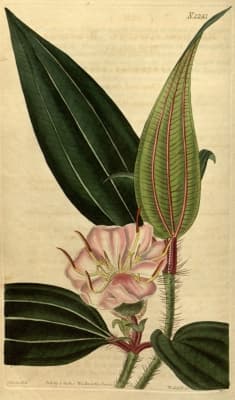
Melastomataceae FAMILY
Melastoma sanguineum
Melastoma sanguineum
Edibility
1/5
Medicinal
3/5
Safety & Hazards
None known
Cultivation Details
HabitEvergreen Tree
Growth—
The plant is often grown as an ornamental - in Hawaii it has proved to be an invasive shrub that can spread rapidly and may form dense monotypic thickets in a variety of habitats such as: open land, grassland, shrubland and native forest[1].
Propagation
Seed - best sown fresh in a nursery seedbed, or in containers because of the small size of the seed. Germination is best in either full sun or in light shade[2]. In trials, the seed germinated within 25 - 50 days[2]. Cite as: Tropical Plants Database, Ken Fern. tropical.theferns.info. 2026-02-20. <tropical.theferns.info/viewtropical.php?id=Melastoma+sanguineum>
Pollinators
Insects
References
- [1]Global Invasive Species Database — http://www.issg.org/database/welcome/ ↩︎Very detailed information on almost 400 species (with more being added) of plants that have become weeds in areas outside their native range.
- [2]Plant Resources of Southeast Asia — http://proseanet.org/ ↩︎Lots of information on the uses of the plants of SE Asia.
- [3]Flora of China — Missouri Botanical Garden Press; St. Louis. · 1994 · http://flora.huh.harvard.edu/china/ ↩︎An excellent, comprehensive resource in 25 volumes. In addition to the botanical information the flora also gives basic information on habitat and some uses. An on-line version is also available.
- [4]Revision of the Southeast Asian Genus Melastoma (Melastomataceae) — Meyer K. · 2001 ↩︎
- [5]Medicinal Plants of Vietnam, Cambodia and Laos. — Nguyen Van Duong · Mekong Printing; Vietnam (Printers) · 1993 · ISBN 0-9837303-1-2 ↩︎Published by the author, this is an excellent book on the medicinal attributes of plants growing in the area that used to be called Indo-China.
- [PFAF]Plants for a Future — pfaf.org ↩︎