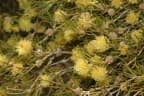
Melaleuca uncinata
Melaleuca uncinata
Safety & Hazards
None known
Cultivation Details
A plant of mainly warm temperate to subtropical areas, just moving into the tropical zone in Queensland. It is known to tolerate temperatures down to at least -7°c when dormant, though only if the wood has been properly ripened by a hot growing season. Requires a fertile, well-drained moisture retentive lime-free soil in full sun[1]. Prefers a soil that does not contain much nitrogen[2]. Seed takes about 12 months to develop on the plant, the woody seed capsules persist for 3 or more years[3]. Any pruning is best done after the plants have flowered with the intention of maintaining a compact habit[3]. Hybridizes freely with other members of this genus[3]. Plants in this genus are notably resistant to honey fungus[3].
Propagation
Seed - surface sow in spring or autumn onto a pot of permanently moist soil in a warm greenhouse. Emmerse in 5cm of water and do not water from overhead. Grow on until the seedlings are 0.5cm tall then remove from the water and pot up a week later. Seedlings are liable to damp off when grown this way, sowing the seed thinly, good ventilation and hygiene are essential for success[3]. Grow the plants on for at least their first winter in a greenhouse and then plant them out in late spring or early summer, after the last expected frosts. Consider giving the plants some protection from the cold for their first few winters outdoors. Cuttings of half-ripe lateral shoots with a heel, mid summer in a frame[3]. Cite as: Temperate Plants Database, Ken Fern. temperate.theferns.info. 2026-02-21. <temperate.theferns.info/plant/Melaleuca+uncinata>
Pollinators
Insects
References
- [1]Ornamental Shrubs, Climbers and Bamboos. — Thomas. G. S. · Murray · 1992 · ISBN 0-7195-5043-2 ↩︎Contains a wide range of plants with a brief description, mainly of their ornamental value but also usually of cultivation details and varieties.
- [2]The RHS Gardener's Encyclopedia of Plants and Flowers — Brickell. C. · Dorling Kindersley Publishers Ltd. · 1990 · ISBN 0-86318-386-7 ↩︎Excellent range of photographs, some cultivation details but very little information on plant uses.
- [3]The New RHS Dictionary of Gardening. 1992. — Huxley. A. · MacMillan Press · 1992 · ISBN 0-333-47494-5 ↩︎Excellent and very comprehensive, though it contains a number of silly mistakes. Readable yet also very detailed.
- [4]Flora of New South Wales — http://plantnet.rbgsyd.nsw.gov.au/floraonline.htm ↩︎An on-line resource giving a brief botanical description of all the native plants of New South Wales, their habitat and range, together with diagrams and photographs of the plants.
- [5]Australian Medicinal Plants. — Lassak. E. V. and McCarthy. T. · New Holland Publishers · 2001 · ISBN 1876334703 ↩︎A very good and readable guide to the subject.
- [6]Dictionary of Economic Plants. — Uphof. J. C. Th. · Weinheim · 1959 · ISBN - ↩︎An excellent and very comprehensive guide but it only gives very short descriptions of the uses without any details of how to utilize the plants. Not for the casual reader.
- [7]Flora of Victoria. — Ewart. A. J. · University Press; Melbourne · 1930 ↩︎A flora of eastern Australia, it is rather short on information that is useful to the plant project.
- [8]Australian Native Plants. — Wrigley. J. W. and Fagg. M. · Collins. (Australia) · 1988 · ISBN 0-7322-0021-0 ↩︎A lovely book, written in order to encourage Australian gardeners to grow their native plants. A little bit of information for the plant project.