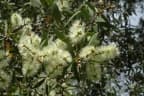
Melaleuca quinquenervia
Melaleuca quinquenervia
Safety & Hazards
To many people, the species is undesirable because of its reputation for causing respiratory problems[1].
Cultivation Details
A plant of tropical and subtropical regions, in the south of its natural range it occurs in the warm subhumid and humid climatic zones and in the north is found in the hot humid zone[1]. It is found at elevations from sea level to 1,000 metres, depending on latitude, growing in areas where the mean annual temperature ranges from 17 - 26°c and the mean annual rainfall is 800 - 3,440 mm[1]. It can tolerate a dry season of 0 - 7 months a year[1]. Plants can tolerate occasional light frosts, but severe frosts will defoliate and kill the branches[1, 2]. The tree will often recover by epicormic sprouting[1]. Grows on most soil types varying from wet clays to saline and dry[1, 2]. Tolerant of salt-laden winds[1]. Plants can tolerate prolonged flooding and a fluctuating water table[1]. Plants have succeeded in calcareous sands and also in acid conditions with a pH as low as 4.5[2]. The species seeds profusely and can become a weed, especially where periodic fires provide a suitable seedbed[1]. The plant has escaped from cultivation and become naturalised in many areas of the tropics and subtropics[1]. In many areas it has become an undesirable weed, being particularly invasive in wetlands[1, 2]. Growth is relatively fast on sites where water is abundant and soils are deep but is not impressive under marginal conditions[1]. The plant flowers prolifically, and in Florida flowering occurs by the age of three[2]. Seedlings less than 1 metre tall have been known to flower[2]. The minute seeds begin to be produced when the trees are 3-4 years old and are only released from the fruit when the branches are subjected to fire, frost, wind breakage, natural pruning, or other damage that disrupts the capsules' vascular systems, causing them to dehisce[1, 2]. Trees are highly fire tolerant during all but the early seedling stages[1]. Trees have the ability to coppice readily, but root suckers are not commonly produced[1]. The leaves have a resinous odour and taste when crushed[1].
Propagation
Seed - it can be sown either onto germination beds or directly into nursery containers. When the seedlings are 2 - 3 cm high (usually 4 - 8 weeks after sowing), they are either transplanted or thinned, depending on the sowing method used[1]. Because the seeds are so small, care is needed to ensure that the sowing mix does not dry out, any diseases are avoided or controlled, and that seed and small seedlings are not damaged or washed away by careless watering[1]. Seed storage behaviour is orthodox; no loss in viability after 4 years of storage at 30% and up to 75% relative humidity at 10°c[1]. Many species within the genus are vegetatively propagated from cuttings or by micropropagation, and these techniques should also be successful with this species[1]. Cite as: Tropical Plants Database, Ken Fern. tropical.theferns.info. 2026-02-20. <tropical.theferns.info/viewtropical.php?id=Melaleuca+quinquenervia>
Pollinators
Insects
References
- [1]World Agroforesty Centre — http://www.worldagroforestry.org/ ↩︎An excellent online database of a huge range of trees giving very good information on each plant - its uses, ecology, identity, propagation, pests etc.
- [2]Tropical Tree Seed Manual — Vosso. J. Editor. · USDA Forest Service. · 2002 · http://www.rngr.net/Publications/ttsm ↩︎An extremely good guide, it can also be downloaded in its entirety from the address shown above.
- [3]Handbook of Energy Crops — Duke. J. · - · 1983 · https://hort.purdue.edu/newcrop/duke_energy/dukeindex.html · ISBN - ↩︎Published only on the Internet, excellent information on a wide range of both temperate and tropical plants.
- [4]Cornucopia II — Facciola. S. · Kampong Publications, California. · 1998 · ISBN 0-9628087-2-5 ↩︎The second edition of an excellent guide to the edible uses of plants, though it does not give any details of cultivation etc.
- [5]Tropical Timbers of the World. Ag. Handbook No. 607. — Chudnoff. Martin. · USDA Forest Service. Wisconsin. · 1984 ↩︎Terse details on the properties of the wood of almost 400 species of trees from the Tropics.