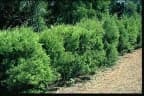
Melaleuca alternifolia
Melaleuca alternifolia
Safety & Hazards
None known
Cultivation Details
Melaleuca alternifolia is a plant of the warm, moist subtropics of eastern Australia, where it can be found at elevations up to 300 metres, the plant is also sometimes cultivated as an ornament in tropical areas[1]. It is found in frost-free areas where daytime temperatures can range from 17 - 19°c up to 27 - 31°c, and the mean annual rainfall is 1,000 - 1,600mm[2]. Although not very cold hardy, the plant can tolerate short periods with temperatures down to at least -7°c when dormant, so long as the summers have been sufficiently hot enough to thoroughly ripen the wood. It can therefore be cultivated in areas such as the Mediterranean where hot summers are followed by mild winters[3, PFAF]. Requires a fertile, well-drained moisture retentive lime-free soil in full sun[4]. Prefers a soil that does not contain much nitrogen[5]. Plants are shade tolerant and succeed in most soils and aspects except dry conditions when they are grown in Australian gardens[3]. Plants can tolerate a pH from 4.5 - 7[2]. Harvesting of the leafy twigs for their essential oil starts 15 - 18 months after establishment of the plants, and subsequently at 12 - 15 month intervals[1]. The shoots are cut when less than 2cm in diameter and at 5 - 10cm above soil level[1]. Annual yield of shoots is about 8 - 10 tonnes per hectare, the shoots having an oil content of 1 - 2%[1]. Seed takes about 12 months to develop on the plant, the woody seed capsules persist for 3 or more years[6]. Any pruning is best done after the plants have flowered with the intention of maintaining a compact habit[6]. Hybridizes freely with other members of this genus[6]. Plants in this genus are notably resistant to honey fungus[6].
Propagation
Seed - surface sow in spring or autumn onto a pot of permanently moist soil in a warm greenhouse. Emmerse in 5cm of water and do not water from overhead. Grow on until the seedlings are 0.5cm tall then remove from the water and pot up a week later. Seedlings are liable to damp off when grown this way, sowing the seed thinly, good ventilation and hygiene are essential for success[6]. Grow the plants on for at least their first winter in a greenhouse and then plant them out in late spring or early summer, after the last expected frosts. Consider giving the plants some protection from the cold for their first few winters outdoors. Cuttings of half-ripe lateral shoots with a heel, mid summer in a frame[6]. Cite as: Temperate Plants Database, Ken Fern. temperate.theferns.info. 2026-02-21. <temperate.theferns.info/plant/Melaleuca+alternifolia>
Pollinators
Insects
References
- [1]Plant Resources of Southeast Asia — http://proseanet.org/ ↩︎Lots of information on the uses of the plants of SE Asia.
- [2]World Agroforesty Centre — http://www.worldagroforestry.org/ ↩︎An excellent online database of a huge range of trees giving very good information on each plant - its uses, ecology, identity, propagation, pests etc.
- [3]Australian Native Plants. — Wrigley. J. W. and Fagg. M. · Collins. (Australia) · 1988 · ISBN 0-7322-0021-0 ↩︎A lovely book, written in order to encourage Australian gardeners to grow their native plants. A little bit of information for the plant project.
- [4]Ornamental Shrubs, Climbers and Bamboos. — Thomas. G. S. · Murray · 1992 · ISBN 0-7195-5043-2 ↩︎Contains a wide range of plants with a brief description, mainly of their ornamental value but also usually of cultivation details and varieties.
- [5]The RHS Gardener's Encyclopedia of Plants and Flowers — Brickell. C. · Dorling Kindersley Publishers Ltd. · 1990 · ISBN 0-86318-386-7 ↩︎Excellent range of photographs, some cultivation details but very little information on plant uses.
- [6]The New RHS Dictionary of Gardening. 1992. — Huxley. A. · MacMillan Press · 1992 · ISBN 0-333-47494-5 ↩︎Excellent and very comprehensive, though it contains a number of silly mistakes. Readable yet also very detailed.
- [7]Useful Wild Plants in Australia. — Cribb. A. B. and J. W. · William Collins Pty Ltd. Sidney · 1981 · ISBN 0-00-216441-8 ↩︎A very readable book.
- [8]The Encyclopedia of Medicinal Plants — Chevallier. A. · Dorling Kindersley. London · 1996 · ISBN 9-780751-303148 ↩︎An excellent guide to over 500 of the more well known medicinal herbs from around the world.
- [9]Encyclopaedia of Herbs and their Uses. — Bown. D. · Dorling Kindersley, London. · 1995 · ISBN 0-7513-020-31 ↩︎A very well presented and informative book on herbs from around the globe. Plenty in it for both the casual reader and the serious student. Just one main quibble is the silly way of having two separate entries for each plant.
- [10]Aromatherapy - A guide for home use. — Westwood. C. · Amberwood Publishing Ltd · 1993 · ISBN 0-9517723-0-9 ↩︎An excellent little pocket guide. Very concise.
- [11]A Field Guide to Australian Trees. — Holliday. I. and Hill. R. · Frederick Muller Ltd. · 1974 · ISBN 0-85179-627-3 ↩︎A well illustrated and very readable book, but it does not contain much information for the plant project.
- [PFAF]Plants for a Future — pfaf.org ↩︎