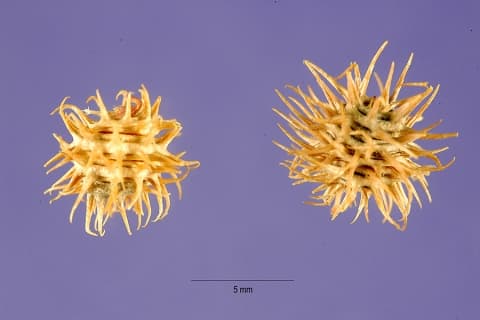
Medicago laciniata
Medicago laciniata
Safety & Hazards
None known
Cultivation Details
Medicago laciniata is a plant of arid and semi-arid areas from the warm temperate to the tropical zones, where it is found at elevations up to 400 metres. It grows best in areas where annual daytime temperatures are within the range 15 - 20°c, but can tolerate 4 - 25°c[1]. It prefers a mean annual rainfall in the range 350 - 500mm, but tolerates 250 - 600mm[1]. Requires a sunny position in a light, well-drained soil[1]. Succeeds in soils of low to moderate fertility[1]. Prefers a pH in the range 6.5 - 7.5, tolerating 6 - 8[1]. Established plants are drought tolerant[1]. This species has a symbiotic relationship with certain soil bacteria, these bacteria form nodules on the roots and fix atmospheric nitrogen. Some of this nitrogen is utilized by the growing plant but some can also be used by other plants growing nearby[2].
Propagation
Pre-soak the seed for 12 hours in warm water and then sow in spring in situ[2]. Cite as: Temperate Plants Database, Ken Fern. temperate.theferns.info. 2026-02-21. <temperate.theferns.info/plant/Medicago+laciniata>
Pollinators
Self
References
- [1]Ecocrop — http://ecocrop.fao.org/ecocrop/srv/en/home ↩︎Basic information on a wide range of useful plants, plus details of environmental needs where available.
- [2]The New RHS Dictionary of Gardening. 1992. — Huxley. A. · MacMillan Press · 1992 · ISBN 0-333-47494-5 ↩︎Excellent and very comprehensive, though it contains a number of silly mistakes. Readable yet also very detailed.
- [3]Flora of the USSR. — Komarov. V. L. · Israel Program for Scientific Translation · 1968 · http://www.biodiversitylibrary.org · ISBN - ↩︎An immense (25 or more large volumes) and not yet completed translation of the Russian flora. Full of information on plant uses and habitats but heavy going for casual readers. It can be downloaded from the Internet.
- [4]African Flowering Plants Database — Conservatoire et Jardin Botaniques. · http://www.ville-ge.ch/musinfo/bd/cjb/africa/recherche.php ↩︎Contains information on over 150,000 plant names (including synonyms) giving a description and habitat, plus a distribution map.
- [5]Cornucopia II — Facciola. S. · Kampong Publications, California. · 1998 · ISBN 0-9628087-2-5 ↩︎The second edition of an excellent guide to the edible uses of plants, though it does not give any details of cultivation etc.
- [6]Screening of some indigenous Qatari medicinal plants for antimicrobial activity — Adel M Mahasneh · 2002 · https://doi.org/10.1002/ptr.1037 ↩︎