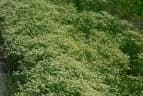
Matricaria chamomilla
Matricaria chamomilla
Safety & Hazards
Individuals allergic to ragweeds (Ambrosia spp.) or with known sensitivity to other members of the Compositae family should avoid contact with German camomile and its products. Camomile hypersensitivity is rare, however[1].
Cultivation Details
German chamomile is a plant of the temperate zone, where it can be found wild as far north as latitude 64°N. It has become naturalized in higher areas of the tropics, such as Ecuador at over 3,000 metres, and is also cultivated at lower elevations in some areas, such as Java[1, 2]. It grows best in areas where annual daytime temperatures are within the range 19 - 25°c, but can tolerate 6 - 30°c[2]. When dormant, the plant can survive temperatures down to about -5°c, but young growth can be severely damaged at 0°c[2]. It prefers a mean annual rainfall in the range 700 - 1,000mm, but tolerates 300 - 1,300mm[2]. An easily grown plant, it succeeds in any well-drained soil in a sunny position and can tolerate light shade[3, 2]. It prefers neutral to slightly acid conditions and succeeds in poor soils and moderately saline conditions[4, 2]. Prefers a pH in the range 5.5 - 6.5, tolerating 5 - 7[2]. It usually self-sows freely when well-sited[PFAF]. The average yield is 0.5 - 2 tonnes of fresh flowers per hectare, from which 100 - 500 kilos of dry material can be produced. With mechanized harvesting, 4 - 8 tonnes of flowery stems can be harvested for the production of essential oil[2]. The whole plant has a pungent aroma[5].
Propagation
Seed - sow spring or autumn in situ[4]. Germination should take place within 3 weeks. Cite as: Temperate Plants Database, Ken Fern. temperate.theferns.info. 2026-02-21. <temperate.theferns.info/plant/Matricaria+chamomilla>
Pollinators
Bees, Flies
References
- [1]Plant Resources of Southeast Asia — http://proseanet.org/ ↩︎Lots of information on the uses of the plants of SE Asia.
- [2]Ecocrop — http://ecocrop.fao.org/ecocrop/srv/en/home ↩︎Basic information on a wide range of useful plants, plus details of environmental needs where available.
- [3]The New RHS Dictionary of Gardening. 1992. — Huxley. A. · MacMillan Press · 1992 · ISBN 0-333-47494-5 ↩︎Excellent and very comprehensive, though it contains a number of silly mistakes. Readable yet also very detailed.
- [4]Encyclopaedia of Herbs and their Uses. — Bown. D. · Dorling Kindersley, London. · 1995 · ISBN 0-7513-020-31 ↩︎A very well presented and informative book on herbs from around the globe. Plenty in it for both the casual reader and the serious student. Just one main quibble is the silly way of having two separate entries for each plant.
- [5]Scented Flora of the World. — Genders. R. · Robert Hale. London. · 1994 · ISBN 0-7090-5440-8 ↩︎An excellent, comprehensive book on scented plants giving a few other plant uses and brief cultivation details. There are no illustrations.
- [6]Hamlyn Encyclopaedia of Plants. — Triska. Dr. · Hamlyn · 1975 · ISBN 0-600-33545-3 ↩︎Very interesting reading, giving some details of plant uses and quite a lot of folk-lore.
- [7]Flora of the British Isles. — Clapham, Tutin and Warburg. · Cambridge University Press · 1962 · ISBN - ↩︎A very comprehensive flora, the standard reference book but it has no pictures.
- [8]Flora Europaea — ? · Cambridge University Press · 1964 · ISBN - ↩︎An immense work in 6 volumes (including the index). The standard reference flora for Europe, it is very terse though and with very little extra information. Not for the casual reader.
- [9]Edible Ornamental Garden. — Bryan. J. and Castle. C. · Pitman Publishing · 1976 · ISBN 0-273-00098-5 ↩︎A small book with interesting ideas for edible plants in the ornamental garden.
- [10]The Herb Book. — Lust. J. · Bantam books · 1983 · ISBN 0-553-23827-2 ↩︎Lots of information tightly crammed into a fairly small book.
- [11]The Gardener's Assistant. — Thompson. B. · Blackie and Son. · 1878 · ISBN - ↩︎Excellent general but extensive guide to gardening practices in the 19th century. A very good section on fruits and vegetables with many little known species.
- [12]A Modern Herbal. — Grieve. · Penguin · 1984 · ISBN 0-14-046-440-9 ↩︎Not so modern (1930's?) but lots of information, mainly temperate plants.
- [13]The Encyclopedia of Medicinal Plants — Chevallier. A. · Dorling Kindersley. London · 1996 · ISBN 9-780751-303148 ↩︎An excellent guide to over 500 of the more well known medicinal herbs from around the world.
- [14]Encyclopaedia of Medicinal Plants. — Chiej. R. · MacDonald · 1984 · ISBN 0-356-10541-5 ↩︎Covers plants growing in Europe. Also gives other interesting information on the plants. Good photographs.
- [15]Medicinal Plants of China — Duke. J. A. and Ayensu. E. S. · Reference Publications, Inc. · 1985 · ISBN 0-917256-20-4 ↩︎Details of over 1,200 medicinal plants of China and brief details of their uses. Often includes an analysis, or at least a list of constituents. Heavy going if you are not into the subject.
- [16]The Complete Homeopathy Handbook. — Castro. M. · Macmillan. London. · 1990 · ISBN 0-333-55581-3 ↩︎A concise beginner's guide to the subject. Very readable.
- [17]Complete Guide to Herbs. — Holtom. J. and Hylton. W. · Rodale Press · 1979 · ISBN 0-87857-262-7 ↩︎A good herbal.
- [18]Companion Planting for Successful Gardening. — Riotte. L. · Garden Way, Vermont, USA. · 1978 · ISBN 0-88266-064-0 ↩︎Fairly good.
- [19]Nature's Colors - Dyes from Plants. — Grae. I. · MacMillan Publishing Co. New York. · 1974 · ISBN 0-02-544950-8 ↩︎A very good and readable book on dyeing.
- [20]Companion Plants. — Philbrick H. and Gregg R. B. · Watkins · 1979 · ISBN - ↩︎Details of beneficial and antagonistic relationships between neighbouring plants.
- [21]Commonsense Compost Making. — Bruce. M. E. · Faber · 1977 · ISBN 0-571-09990-4 ↩︎Excellent little booklet dealing with how to make compost by using herbs to activate the heap. Gives full details of the herbs that are used.
- [22]Dictionary of Economic Plants. — Uphof. J. C. Th. · Weinheim · 1959 · ISBN - ↩︎An excellent and very comprehensive guide but it only gives very short descriptions of the uses without any details of how to utilize the plants. Not for the casual reader.
- [PFAF]Plants for a Future — pfaf.org ↩︎