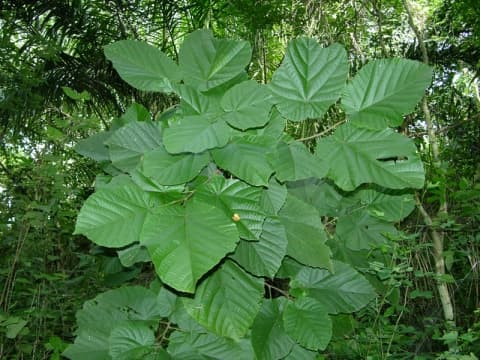
Mansonia altissima
Mansonia altissima
Safety & Hazards
The bark is very poisonous and in parts of south-western Côte d’Ivoire it is the main component of a very effective arrow-poison, also used in spear traps for large game. In other parts of its range the bark is a component of arrow poisons too[1]. In processing, the wood produces high levels of dust which can cause serious health problems to workers. The dust may cause dermatitis, nose-bleeding, throat irritation, asthma and eczema, the reactions becoming stronger on repeated exposure. Heart troubles have also been reported. Pigs given the sawdust as litter developed severe contact dermatitis and piglets even died. The toxins in the wood, even in the form of thin veneer, are resistant to oxidation and are heat-stable; they remain effective for many years[1]. Ethanol and chloroform extracts of the bark have shown a very strong toxicity against several mammals[1].
Cultivation Details
Mansonia altissima is characteristic of the dense semi-deciduous forest in areas with about 1,600mm annual rainfall and a pronounced dry season. The southern limit of its distribution area largely corresponds with the transition of semi-deciduous forest to evergreen forest; to the north its distribution extends to patches of dense forest in the savannah[1]. Seedlings are most common on fertile soils on drier sites; they are fairly drought resistant. During their first 2 years after germination, slight shade stimulates growth and the formation of healthy leaves. Leaves are held vertically in exposed conditions, more horizontally in the shade. After 2 years, however, the tree requires full sunlight and has been classified as a non-pioneer light demander[1]. Seedlings attained a height of 1 - 2 metres within 4 years when growing in natural forest, and 6 metres in 4 years in logged areas. In Kumasi (Ghana) trees attained a bole diameter of 6.5 - 16cm and a height of 8 - 15 metres in 10 years[1]. For plantations in Cameroon faster growth has been recorded, with trees growing 2 metres in height per year after 2 years decreasing to 1.3 metres per year after 10 years[1]. In Côte d’Ivoire mean annual bole diameter growth of Mansonia altissima trees for all diameter classes was 2.5 - 7mm. Mean growth for the diameter class 30 - 50cm was 5.1mm per year. An average tree would reach a bole diameter of 50cm in 90 years[1]. Freshly cut logs are usually too heavy to be transported by river[1].
Propagation
Seed - germination starts after about 10 days and may take one week, but a dormancy period of several months has also been observed[1]. Dormancy caused little loss of seed viability. Germination occurs under both light and dark conditions, but is strongly depressedin large gaps in the forest[1]. Cite as: Tropical Plants Database, Ken Fern. tropical.theferns.info. 2026-02-20. <tropical.theferns.info/viewtropical.php?id=Mansonia+altissima>
Pollinators
Data unavailable
References
- [1]Protabase - Plant Resources of Tropical Africa. — http://www.prota.org ↩︎An excellent on-line database with detailed information on over 3,200 species of useful plants of Africa.
- [2]Tropical Timbers of the World. Ag. Handbook No. 607. — Chudnoff. Martin. · USDA Forest Service. Wisconsin. · 1984 ↩︎Terse details on the properties of the wood of almost 400 species of trees from the Tropics.
- [3]Tropix 7 — CIRAD · http://tropix.cirad.fr/en ↩︎An on-line guide to the timbers of 245 species of trees.