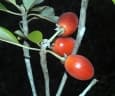
Manilkara kauki
Manilkara kauki
Safety & Hazards
None known
Cultivation Details
A plant of the lowland tropics, also succeeding in subtropical areas[1, 2]. It is usually found in drier areas and below elevations of 500 metres[1]. Plants are tolerant of light frosts[2]. Prefers sandy loam soils[1]. Tolerates a wide range of soils[2]. Plants can flower and fruit all year round in some of the areas in which the plant grows[1].
Propagation
Seed - clean, processed seed do not have dormancy and require no pre-treatment[3]. However, soaking seeds in water for three periods of 24 hours (using fresh water each time) prior to sowing may enhance germination rates[3]. The seed is best sown in a shady position, either in individual containers or a nursery seedbed[1, 3]. Germination starts 2.5 - 5 weeks after sowing[1]. Prick out the seedlings into individual containers when they are large enough to handle and plant them out into permanent positions when they are 12 months old or have at least four true leaves[3]. Seedlings are transplanted into the field when they are about 45 cm tall[1]. Experiments have shown that the position of the seed in the soil is important for successful germination. Germination occurs most rapidly when the longitudinal axis of the seed is in a horizontal position[1]. When seeds are soaked in an ethephon or chlormequat chloride solution for 24 hours, 55 - 66% of the seeds germinate[1]. Nodal cuttings 20 - 25cm long, treated with rooting hormone and planted in sand will usually start rooting after 8 - 10 weeks with more than 50% rooting success[3]. Cite as: Tropical Plants Database, Ken Fern. tropical.theferns.info. 2026-02-20. <tropical.theferns.info/viewtropical.php?id=Manilkara+kauki>
Pollinators
Data unavailable
References
- [1]World Agroforesty Centre — http://www.worldagroforestry.org/ ↩︎An excellent online database of a huge range of trees giving very good information on each plant - its uses, ecology, identity, propagation, pests etc.
- [2]Perennial Edible Fruits of the Tropics : an Inventory — Martin, F. W.; Campbell, C. W.; Rubertbe, R. M. · U.S. Dept. of Agriculture, Agricultural Research Service · 1987 ↩︎A booklet giving terse details of almost 300 species of edible fruits, plus regional lists of Botanical and Common names for over 2,500 less well-known edible fruits of the tropics.
- [3]Seed Leaflets — Various · Forest & Landscape. Denmark · http://en.sl.life.ku.dk/Publikationer/Udgivelser/PopulaerPublikationer.aspx?katid={D28373CC-6EF3-4EF8-B097-6D83FABF209E}&serieid={9F1C3DB1-6E7B-4CF1-AF53-F480B0CB40EF}&sort=title ↩︎A series of leaflets, jointly produced by the University of Copenhagen and the Royal Botanic Gardens at Kew, focussing on seed information for a number species, but also giving a lot of other information about each plant.
- [4]Cornucopia II — Facciola. S. · Kampong Publications, California. · 1998 · ISBN 0-9628087-2-5 ↩︎The second edition of an excellent guide to the edible uses of plants, though it does not give any details of cultivation etc.
- [5]Mansfeld's Database of Agricultural and Horticultural Plants — http://mansfeld.ipk-gatersleben.de/pls/htmldb_pgrc/f?p=185:3:4292127278597336 ↩︎Terse details of a huge range of useful plants.