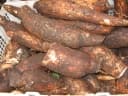
Cultivation Details
Cassava grows best at elevations below 1,700 metres[2]. Plants do not grow well at temperatures lower than 16°c, the stems and leaves are very sensitive to even short periods of chilling[2]. Temperatures in excess of 29°c may have an adverse effect on growth and development[2]. Plants grow best in areas where rainfall is in the range of 500 - 2,500mm per annum[2]. A short-day plant, tuber production is reduced in daylengths greater than 12 hours[2]. Plants need some shelter from bright sunshine or their leaves can be burnt[3]. A quite tolerant plant, succeeding in drier and moister soils as well as in quite deep shade[4]. Cassava is not a particularly greedy plant, though yields are improved if they are well fed[4]. A sandy or sandy loam is generally preferred for growing the plant[2]. Requires a well-drained soil[2]. Some cultivars are extremely drought resistant[2]. Tolerates a pH in the range 5.5 - 8.0[2]. The plant grows, and can be harvested, all year round[4]. The roots take about six months to mature, so it is possible to grow two crops a year[4]. The roots are often badly damaged by termites[4]. There are many named varieties. There are two groups of cultivars, the sweet and the bitter[2]. Sweet forms contain much less hydrocyanic acid, and this is confined mainly to the outer phellodern layers of the root tuber[2]. In bitter varieties the hydrocyanic acid is widely distributed throughout the tuber[2]. Care must be taken to grow the cultivated 'sweet' varieties that have been developed as food crops - ornamental, usually variegated, forms are usually bitter tasting and poisonous[4]. The leaves are particularly susceptible to damage by insecticide sprays[4]. Cassava will usually grow into a tall spindly bush unless cut back - they are very tolerant of heavy harvesting and so in cultivation it is best to keep them at about 1 metre tall[4].
Propagation
Seed - seedlings are very unlikely to be true to type and could possibly revert to bitter types. Cuttings - they root easily[4]. Take shoots about 30cm long and 15mm thick from a woody part of the stem and remove all leaves. It is possible to root the shoots by standing them in a container of water, planting them out when they have made good roots. Alternatively, plant the cuttings out directly in the soil making sure that they are kept moist[4]. Cite as: Tropical Plants Database, Ken Fern. tropical.theferns.info. 2026-02-20. <tropical.theferns.info/viewtropical.php?id=Manihot+esculenta>
Pollinators
Insects
References
- [1]Edible Leaves of the Tropics — Martin. F. W.; Ruberte. R. M. & Meitzner. L. S. · Echo. USA. · 1998 · ISBN 0-9653360-1-8 ↩︎A terse guide, giving reasonable detail on the more common leaf crops and brief information on a wide range of lesser known plants.
- [2]Vegetables in the Tropics — Tindall. H. D. · MacMillan, Oxford. · 1983 · ISBN 0-333-24268-8 ↩︎An excellent, in-depth look at the main vegetable crops that can be grown in the Tropics, plus many less well-known plants.
- [3]The New RHS Dictionary of Gardening. 1992. — Huxley. A. · MacMillan Press · 1992 · ISBN 0-333-47494-5 ↩︎Excellent and very comprehensive, though it contains a number of silly mistakes. Readable yet also very detailed.
- [4]Tropical Food Gardens — Norrington. L. · Bloomings Books (Melbourne) · 2001 · ISBN 1-876473-41-x ↩︎Excellent little book giving some basic information on a range of plants.
- [5]Cornucopia II — Facciola. S. · Kampong Publications, California. · 1998 · ISBN 0-9628087-2-5 ↩︎The second edition of an excellent guide to the edible uses of plants, though it does not give any details of cultivation etc.
- [6]Dictionary of Economic Plants. — Uphof. J. C. Th. · Weinheim · 1959 · ISBN - ↩︎An excellent and very comprehensive guide but it only gives very short descriptions of the uses without any details of how to utilize the plants. Not for the casual reader.
- [7]Medicinal Plants in the South Pacific — WHO Regional Publications, Manilla. · 1998 · ISBN 92-9061-118-9 ↩︎Excellent guide to 102 medicinal herbs of the Pacific Islands, with photographs of each plant and details of their constituents, biological activities and traditional uses. A description of each plant, together with habitat and distribution is given.
- [8]Medicinal Plants of the Guianas — DeFilipps, R. A.; Maina, S. L.; & Crepin, J. · Smithsonian Museum · http://botany.si.edu/bdg/medicinal/index.html ↩︎A down-loadable PDF document of a book in pre-publication awaiting illustration. An excellent, if rather terse, guide to the traditional medicinal uses of the plants of the region
- [9]The Encyclopedia of Medicinal Plants — Chevallier. A. · Dorling Kindersley. London · 1996 · ISBN 9-780751-303148 ↩︎An excellent guide to over 500 of the more well known medicinal herbs from around the world.