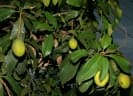
Cultivation Details
A tree of lowland tropical areas, thriving at elevations below 1,000 metres[1]. It is found most often in areas with a fairly heavy rainfall that is equally distributed throughout the year, although it also grows in areas with a moderate rainfall provided there are no prolonged dry periods[1], and in monsoon climates[1, 3]. It is known to succeed in areas where the mean annual rainfall can range from 1,200 - 3,267mm, the annual minimum temperature is 18 - 24°c, the maximum annual temperature is 21 - 33°c and annual mean temperature 25 - 28°c[1]. Tolerant of a variety of soil conditions[1]. Seedling plants usually take 6 - 9 years before producing fruit[3]. The tree can produce two crops a year in areas where two dry seasons prevail[1]. This species possibly represents hybrid forms between M. indica and M. foetida[1]. A polymorphic species, several forms are distinguished: - 'Bembem' is an inferior form. The fruit has a strong smell and taste of turpentine reminiscent of the fruit of M. foetida, the leaves are coriaceous[1]. 'Kaweni' has less fibrous flesh and a mild taste of turpentine. The best forms are very palatable[1]. 'Gandarassa', of the Banten area in West Java, is a rare and poorly known form which is said to be superior to 'kaweni', less sweet but more juicy and with a less strong smell[1]. 'Sangay' is distinguished by its yellow colour at maturity from the greenish 'Huani' fruit[1].
Propagation
Seed - frequently polyembryonic[1]. Cite as: Tropical Plants Database, Ken Fern. tropical.theferns.info. 2026-02-20. <tropical.theferns.info/viewtropical.php?id=Mangifera+odorata>
Pollinators
Insects
References
- [1]World Agroforesty Centre — http://www.worldagroforestry.org/ ↩︎An excellent online database of a huge range of trees giving very good information on each plant - its uses, ecology, identity, propagation, pests etc.
- [2]The Mangoes. Their Botany, Nomenclature, Horticulture and Utilization. — Kostermans A.J.G.H.; & Bompard J.M. · Academic Press; London · 1993 · ISBN 0-12-421920-9 ↩︎A very detailed book about the genus Mangifera, which includes the well-known Mango.
- [3]Perennial Edible Fruits of the Tropics : an Inventory — Martin, F. W.; Campbell, C. W.; Rubertbe, R. M. · U.S. Dept. of Agriculture, Agricultural Research Service · 1987 ↩︎A booklet giving terse details of almost 300 species of edible fruits, plus regional lists of Botanical and Common names for over 2,500 less well-known edible fruits of the tropics.
- [4]IUCN Red List of Threatened Species — http://www.iucnredlist.org/ ↩︎A list of plants under threat and facing possible extinction, usually with brief details of the threats and information on habitat.
- [5]The New RHS Dictionary of Gardening. 1992. — Huxley. A. · MacMillan Press · 1992 · ISBN 0-333-47494-5 ↩︎Excellent and very comprehensive, though it contains a number of silly mistakes. Readable yet also very detailed.
- [6]Flora Malesiana Series 1 — Various · Nationaal Herbarium Nederiand, Universiteit Leiden branch · http://www.archive.org ↩︎A massive treatment of the plants of the Malaysian Archipelago. Much of it has been made available to download from the Internet
- [7]Timber Notes - Light Hardwoods II — Gan K.S.; Lim S.C.; Choo K.T. · Forest Research Institute; Malaysia · 1998 · ISBN 139-258 ↩︎Part of an excellent series of publications, this one giving a brief guide to five lesser known groups of light hardwoods from southeast Asia. It is available in PDF format on the Internet.
- [8]Tropix 7 — CIRAD · http://tropix.cirad.fr/en ↩︎An on-line guide to the timbers of 245 species of trees.