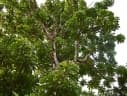
Mangifera kemanga
Mangifera kemanga
Safety & Hazards
Unlike the related Mangifera caesia, the sap of this species does not cause skin irritations or blisters[1].
Cultivation Details
A plant of the wet, tropical lowlands, where it is usually found at elevations below 400 metres, but rarely up to 800 metres[2]. It requires a rainfall which is evenly distributed through the year[2]. The plant stands inundation well and is commonly cultivated on periodically inundated riverbanks in East Kalimantan[2]. Mature trees require much space, 12 - 16 metres each way being typical[2]. Natural hybrids between Mangifera kemanga and Mangifera caesia, showing intermediate characteristics, are found in orchards in East Kalimantan[2].
Propagation
Seed - It is propagated from seed, an indication that the agronomy of the crops has received little attention. Presumably grafting on seedling stock would be possible, in particular through inarching potted, decapitated rootstocks into twigs of mother trees. Grafting on Mangifera indica L. has been attempted without success, probably because this species is not closely related[2]. Cite as: Tropical Plants Database, Ken Fern. tropical.theferns.info. 2026-02-20. <tropical.theferns.info/viewtropical.php?id=Mangifera+kemanga>
Pollinators
Insects
References
- [1]The Mangoes. Their Botany, Nomenclature, Horticulture and Utilization. — Kostermans A.J.G.H.; & Bompard J.M. · Academic Press; London · 1993 · ISBN 0-12-421920-9 ↩︎A very detailed book about the genus Mangifera, which includes the well-known Mango.
- [2]World Agroforesty Centre — http://www.worldagroforestry.org/ ↩︎An excellent online database of a huge range of trees giving very good information on each plant - its uses, ecology, identity, propagation, pests etc.