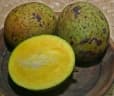
Mangifera foetida
Mangifera foetida
Cultivation Details
A plant of the hot, moist tropical lowlands, adapted to areas with abundant rainfall, evenly distributed over the year[1]. It can be cultivated in areas with a monsoon climate[2, 3, 4]. Succeeds at elevations up to 1,000 metres, occasionally to 1,500 metres[1]. Young plants are tolerant of quite deep shade but later on also grow well in full light[1]. Different forms of the fruit are recognized by local people. Small, almost globose fruits (e.g. 'limus piit' in West Java) are consistently distinguished from large and more oblong ones which are commonly sold in Malay markets[1]. There is also another kind, with large, oblong fruits, remarkable for being hardly fibrous, and finer textured[1]. In West Java, it is called 'limus tipung' ('tipung' meaning flour, referring to its fine texture). A similar kind ('asem linggau') was found in East Kalimantan, with, moreover, a large proportion of fruit having abortive seeds. Sizeable variability in fruit characters is recorded in Borneo, particularly in South Kalimantan[1]
References
- [1]World Agroforesty Centre — http://www.worldagroforestry.org/ ↩︎An excellent online database of a huge range of trees giving very good information on each plant - its uses, ecology, identity, propagation, pests etc.
- [2]Perennial Edible Fruits of the Tropics : an Inventory — Martin, F. W.; Campbell, C. W.; Rubertbe, R. M. · U.S. Dept. of Agriculture, Agricultural Research Service · 1987 ↩︎A booklet giving terse details of almost 300 species of edible fruits, plus regional lists of Botanical and Common names for over 2,500 less well-known edible fruits of the tropics.
- [3]IUCN Red List of Threatened Species — http://www.iucnredlist.org/ ↩︎A list of plants under threat and facing possible extinction, usually with brief details of the threats and information on habitat.
- [4]The Mangoes. Their Botany, Nomenclature, Horticulture and Utilization. — Kostermans A.J.G.H.; & Bompard J.M. · Academic Press; London · 1993 · ISBN 0-12-421920-9 ↩︎A very detailed book about the genus Mangifera, which includes the well-known Mango.
- [5]Flora Malesiana Series 1 — Various · Nationaal Herbarium Nederiand, Universiteit Leiden branch · http://www.archive.org ↩︎A massive treatment of the plants of the Malaysian Archipelago. Much of it has been made available to download from the Internet
- [6]Plants of Southeast Asia — http://www.asianplant.net/ ↩︎Excellent site with brief information on the plant, its range, habitat and uses, plus phots of specimens, close-ops of flowers and leaves etc,
- [7]Timber Notes - Light Hardwoods II — Gan K.S.; Lim S.C.; Choo K.T. · Forest Research Institute; Malaysia · 1998 · ISBN 139-258 ↩︎Part of an excellent series of publications, this one giving a brief guide to five lesser known groups of light hardwoods from southeast Asia. It is available in PDF format on the Internet.
- [8]Tropix 7 — CIRAD · http://tropix.cirad.fr/en ↩︎An on-line guide to the timbers of 245 species of trees.