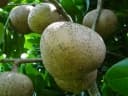
Mammea africana
Mammea africana
Safety & Hazards
The bark is used as fish poison in small streams; its potency is limited[1].
Cultivation Details
A tree of hot, tropical monsoon climates[2]. Young plants tolerate shade, but this should be gradually removed as the tree grows[3]. Prefers a fertile, humus-rich forest soil, where moisture is in abundance, succeeding in both clay and sandy substrates[1, 3]. It has succeeded in base-poor soils[1]. The tree is easy to cultivate, and has been successfully grown in plantations, but growth is slow and overhead shading is necessary[4]. It has also been established by underplanting, and conversely the mature trees are good shade-bearers[4]. A slow-growing tree[4]. The annual growth of saplings is about 30 - 50cm. In Nigeria trees have been reported to reach a height of 15 metres, with a bole diameter of almost 30cm, 24 years after planting[1]. Trees may start flowering at an age of 10 years, but initially without developing fruits. Flowering is irregular[1]. The flowers are morphologically either bisexual or male, the two types occurring on different trees, but pollen research showed that the apparently bisexual flowers are functionally female, having pollen without apertures. This means that Mammea africana is functionally dioecious and at least one tree of each form needs to be grown if fruit is required[1]. Mass fruiting generally occurs every 2 - 3 years[1]. The fruits ripen 10 - 12 months after flowering[1]. Natural regeneration may be abundant under the mother tree[1].
Propagation
Seed - pre-treatment is not necessary, but germination is promoted by carefully filing a hole in the wall of the stone or soaking the seeds in water for 24 hours. Seeds should be sown in shady positions, either in situ, or in nursery seedbeds. Germination is irregular, taking from 3 - 35 weeks. The germination rate is often high; up to 90% for fresh seeds; about 70% for seeds sown 2 - 6 weeks after being harvested; and about 35% for seeds sown 10 weeks after being harvested. Nursery-sown plants can be planted out when around 18 - 24 months old[1]. Cite as: Tropical Plants Database, Ken Fern. tropical.theferns.info. 2026-02-20. <tropical.theferns.info/viewtropical.php?id=Mammea+africana>
Pollinators
Data unavailable
References
- [1]Protabase - Plant Resources of Tropical Africa. — http://www.prota.org ↩︎An excellent on-line database with detailed information on over 3,200 species of useful plants of Africa.
- [2]Perennial Edible Fruits of the Tropics : an Inventory — Martin, F. W.; Campbell, C. W.; Rubertbe, R. M. · U.S. Dept. of Agriculture, Agricultural Research Service · 1987 ↩︎A booklet giving terse details of almost 300 species of edible fruits, plus regional lists of Botanical and Common names for over 2,500 less well-known edible fruits of the tropics.
- [3]World Agroforesty Centre — http://www.worldagroforestry.org/ ↩︎An excellent online database of a huge range of trees giving very good information on each plant - its uses, ecology, identity, propagation, pests etc.
- [4]The Useful Plants of West Tropical Africa. — Burkil. H. M. · Royal Botanic Gardens; Kew. · 1985 - 2004 ↩︎Brief descriptions and details of the uses of over 4,000 plants. A superb, if terse, resource, it is also available electronically on the Web - see http://www.aluka.org/
- [5]Cornucopia II — Facciola. S. · Kampong Publications, California. · 1998 · ISBN 0-9628087-2-5 ↩︎The second edition of an excellent guide to the edible uses of plants, though it does not give any details of cultivation etc.
- [6]Dictionary of Economic Plants. — Uphof. J. C. Th. · Weinheim · 1959 · ISBN - ↩︎An excellent and very comprehensive guide but it only gives very short descriptions of the uses without any details of how to utilize the plants. Not for the casual reader.
- [7]Tropix 7 — CIRAD · http://tropix.cirad.fr/en ↩︎An on-line guide to the timbers of 245 species of trees.