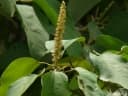
Mallotus philippensis
Mallotus philippensis
Safety & Hazards
Rottlerin, a substance found in kamala powder, has been show to affect the fertility of female rats and guinea pigs, and is reportedly toxic to frogs, worms, and some fish species[1]. In overdoses it causes nausea in humans[1]. The seeds are reported to contain a toxic glycoside[1]. The roots, stems and leaves contain hydrogen cyanide, a poisonous acid[1]. In Sumatra the plant is employed as a fish poison[2].
Cultivation Details
A plant of lower elevations in the tropics, where it can be found from sea level to 1,600 metres[3]. It grows best in areas where annual daytime temperatures are within the range 25 - 34°c, but can tolerate 7 - 45°c[4]. When dormant, the plant can survive temperatures down to about -2°c, but young growth can be severely damaged at 0°c[4]. It prefers a mean annual rainfall in the range 1,000 - 2,500mm, but tolerates 600 - 5,000mm[4]. Succeeds in full sun[4], but plants can also tolerate considerable shade[3]. Prefers a pH in the range 5 - 6.7, tolerating 4.5 - 7.5[4]. Established plants are drought tolerant[3]. The growth is comparatively slow - mean annual girth increment being reported in India at 0.65 cm, with a mean girth after 16 years of less than 15 cm[1].
Propagation
Seed - fairly easily propagated by seeds sown at the beginning of the rainy season in a seed bed in a nursery[3]. As the germination rate is often poor (for example, because of drought and insect attack) it is advisable to sow close, about 5 cm apart, and to thin out later[3]. About 5% germination can be expected in 65 - 82 days[3]. Dried seeds can be stored in gunny bags or in tins in a dry place for about 6 months without losing viability[3]. Suckers. Cite as: Tropical Plants Database, Ken Fern. tropical.theferns.info. 2026-02-20. <tropical.theferns.info/viewtropical.php?id=Mallotus+philippensis>
Pollinators
Ants
References
- [1]Plant Resources of Southeast Asia — http://proseanet.org/ ↩︎Lots of information on the uses of the plants of SE Asia.
- [2]Mansfeld's Database of Agricultural and Horticultural Plants — http://mansfeld.ipk-gatersleben.de/pls/htmldb_pgrc/f?p=185:3:4292127278597336 ↩︎Terse details of a huge range of useful plants.
- [3]World Agroforesty Centre — http://www.worldagroforestry.org/ ↩︎An excellent online database of a huge range of trees giving very good information on each plant - its uses, ecology, identity, propagation, pests etc.
- [4]Ecocrop — http://ecocrop.fao.org/ecocrop/srv/en/home ↩︎Basic information on a wide range of useful plants, plus details of environmental needs where available.
- [5]Euphorbiaceae of Malesia — http://www.nationaalherbarium.nl/euphorbs/ ↩︎An online resource that is still being developed, it gives detailed botanical descriptions of plants in the family Euphorbiaceae found growing in Malesia (the region from Peninsual Malaysia through Indonesia, the Philippines).
- [6]Ethnobotanical Studies of Useful Trees of District Kotli, Azad Jammu and Kashmir — Muhammad Ajaib & Zaheer-Ud-Din Khan · 2014 · ISBN 2313-206X ↩︎
- [7]Medicinal Plants in Papua New Guinea — World Health Organisation · 2009 · ISBN 978-92-9061-249-0 ↩︎Traditional medicinal uses of 126 species from Papua New Guinea, including information on modern research into the plants.