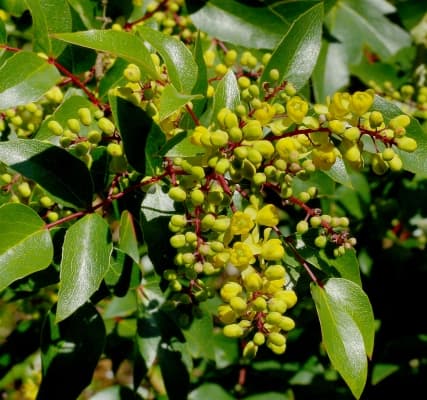
Mahonia gracilis
Mahonia gracilis
Safety & Hazards
All parts of the plant contain the alkaloid berberine - this is most concentrated in the roots, stems and inner bark, and least concentrated in the fruits. In small quantities berberine has a range of effective medicinal applications but, in excess, can cause vomiting, lowered blood pressure, reduced heart rate, lethargy, and other ill-effects. The fruit of most, if not all, members of this genus are more or less edible and can be eaten in quantity since the levels of berberine in the fruit are very low.
Cultivation Details
Mahonia gracilis is mainly native to the warm temperate and subtropical climate of northern Mexico, just entering into the tropics at higher elevations of 1,350 metres or more. Plants are not very cold tolerant, but can tolerate short-lived temperatures down to about -5°c when fully dormant[1]. The young growth in spring is much more sensitive and can be damaged by temperatures around 0°c Unlike most members of this genus, this species requires a dry, well-drained soil in a shady position[1]. It requires a position sheltered from strong or cold winds[2]. Hybridizes freely with other members of this genus. Plants in this genus are resistant to honey fungus[3]. Some Berberis/Mahonia species (especially Berberis vulgaris) harbour the black stem-rust fungus (Puccinia graminis Persoon). This is a major disease of wheat and barley crops and can spread from infected barberries to the grain crop. The sale or transport of susceptible or untested species of Berberis is illegal in the United States and Canada[4]. We have no data on susceptibility for this species[PFAF].
Propagation
Seed - best sown as soon as it is ripe in a cold frame[5]. It usually germinates in the spring[PFAF]. 'Green' seed (harvested when the embryo has fully developed but before the seed case has dried) should be sown as soon as it is harvested and germinates within 6 weeks[PFAF]. Stored seed should be sown as soon as possible in late winter or spring. 3 weeks cold stratification will improve its germination, which should take place in 3 - 6 months at 10°c. Prick out the seedlings when they are large enough to handle and grow them on in a cold frame for at least their first winter. Plant them out in late spring or early summer. Division of suckers in spring[5]. Whilst they can be placed direct into their permanent positions, better results are achieved if they are potted up and placed in a frame until established[6]. Leaf cuttings in the autumn. Cite as: Temperate Plants Database, Ken Fern. temperate.theferns.info. 2026-02-21. <temperate.theferns.info/plant/Mahonia+gracilis>
Pollinators
Insects
References
- [1]Conservatory and Indoor Plants Volumes 1 & 2 — Phillips. R. & Rix. M. · Pan Books, London. · 1998 · ISBN 0-330-37376-5 ↩︎Excellent photos of over 1,100 species and cultivars with habits and cultivation details plus a few plant uses. Many species are too tender for outdoors in Britain though there are many that can be grown outside.
- [2]Climbers and Wall Shrubs. — Davis. B. · Viking. · 1990 · ISBN 0-670-82929-3 ↩︎Contains information on 2,000 species and cultivars, giving details of cultivation requirements. The text is terse but informative.
- [3]The Garden. Volume 112. — RHS. · Royal Horticultural Society · 1987 · ISBN - ↩︎Snippets of information from the magazine of the RHS. In particular, there are articles on plants that are resistant to honey fungus, oriental vegetables, Cimicifuga spp, Passiflora species and Cucurbits.
- [4]Flora of N. America — http://flora.huh.harvard.edu/fna/ ↩︎An on-line version of the flora with an excellent description of the plant including a brief mention of plant uses.
- [5]Propagation of Trees, Shrubs and Conifers. — Sheat. W. G. · MacMillan and Co · 1948 · ISBN - ↩︎A bit dated but a good book on propagation techniques with specific details for a wide range of plants.
- [6]Trees and Shrubs Hardy in Great Britain. Vol 1 - 4 and Supplement. — Bean. W. · Murray · 1981 · ISBN - ↩︎A classic with a wealth of information on the plants, but poor on pictures.
- [7]The New RHS Dictionary of Gardening. 1992. — Huxley. A. · MacMillan Press · 1992 · ISBN 0-333-47494-5 ↩︎Excellent and very comprehensive, though it contains a number of silly mistakes. Readable yet also very detailed.
- [8]The medicinal uses of the genus Mahonia in traditional Chinese medicine: An ethnopharmacological, phytochemical and — Jian-Ming He, Qing Mu · 2016 · http://dx.doi.org/10.1016/j.jep.2015.09.013 · ISBN 0378-8741 ↩︎A review of the medicinal uses of the genus Mahonia in China.
- [9]Medicinal Plants of China — Duke. J. A. and Ayensu. E. S. · Reference Publications, Inc. · 1985 · ISBN 0-917256-20-4 ↩︎Details of over 1,200 medicinal plants of China and brief details of their uses. Often includes an analysis, or at least a list of constituents. Heavy going if you are not into the subject.
- [10]Earth Medicine, Earth Food. — Weiner. M. A. · Ballantine Books · 1980 · ISBN 0-449-90589-6 ↩︎A nice book to read though it is difficult to look up individual plants since the book is divided into separate sections dealing with the different medicinal uses plus a section on edible plants. Common names are used instead of botanical.
- [PFAF]Plants for a Future — pfaf.org ↩︎