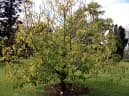
Magnolia doltsopa
Magnolia doltsopa
Safety & Hazards
None known
Cultivation Details
A plant of higher elevations the wet tropics, it can also be cultivated in warm areas of the temperate zone[1]. It is found in the tropics at elevations from 1,500 - 2,400 metres. It grows best in areas where annual daytime temperatures are within the range 30 - 37°c, but can tolerate 5 - 45°c[1]. When dormant, the plant can survive temperatures down to about -2°c, but young growth can be severely damaged at -1°c[1]. It prefers a mean annual rainfall in the range 3,000 - 4,000mm, but tolerates 2,200 - 5,000mm[1]. Prefers a position with part day shade[2]. Prefers a moist but well-drained, loam to clayey fertile soil[2]. Prefers a pH in the range 4.5 - 5, tolerating 4 - 5.5[1]. Prefers a position sheltered from strong winds[2].
Propagation
Seed - Softwood cuttings under mist[2]. Cite as: Tropical Plants Database, Ken Fern. tropical.theferns.info. 2026-02-20. <tropical.theferns.info/viewtropical.php?id=Magnolia+doltsopa>
Pollinators
Data unavailable
References
- [1]Ecocrop — http://ecocrop.fao.org/ecocrop/srv/en/home ↩︎Basic information on a wide range of useful plants, plus details of environmental needs where available.
- [2]Desert Tropicals — http://www.desert-tropicals.com/ ↩︎The main focus of the site is succulent plants, but it also contains information on a wide range of other species. Usually at least one good photograph, plus basic information about the plant and its cultivation.
- [3]Flowers of India — http://www.flowersofindia.net/ ↩︎A wed site of native Indian plants, plus cultivated and naturalized species. It has good quality photos and terse details on more than 3,000 species and cultivars.
- [4]Flora of China — Missouri Botanical Garden Press; St. Louis. · 1994 · http://flora.huh.harvard.edu/china/ ↩︎An excellent, comprehensive resource in 25 volumes. In addition to the botanical information the flora also gives basic information on habitat and some uses. An on-line version is also available.
- [5]Plants and People of Nepal — Manandhar. N. P. · Timber Press. Oregon. · 2002 · ISBN 0-88192-527-6 ↩︎Excellent book, covering over 1,500 species of useful plants from Nepal together with information on the geography and peoples of Nepal. Good descriptions of the plants with terse notes on their uses.