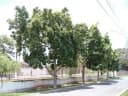
Magnolia champaca
Magnolia champaca
Safety & Hazards
None known
Cultivation Details
A plant of the wet tropics and subtropics, also able to be grown in the warm temperate zone. It is found growing at elevations from near sea level to 2,100 metres[1]. It grows best in areas where annual daytime temperatures are within the range 30 - 37°c, but can tolerate 10 - 47°c[2]. When dormant, the plant can survive temperatures down to about °c, but young growth can be severely damaged at °c[2]. It prefers a mean annual rainfall in the range 3,000 - 4,000mm, but tolerates 2,200 - 5,100mm[2]. Requires a sunny position in a moist but well-drained, deep, fertile, loamy to sandy soil[3, 2]. Prefers a pH in the range 4.5 - 5.5, tolerating 4 - 6[2]. Trees propagated from seed take 8 - 10 years to flower, whereas asexually propagated trees flower in 2 - 3 years[1]. In Java the mean annual increment of 10 - 27-year-old trees is 1 - 1.8 metres in height and 1.5 - 2 cm in diameter[1]. A rotation of 50 years is recommended to produce sawn timber[1]. The tree responds well to coppicing[1] The tree is susceptible to fire[1]. The tree flowers and fruits throughout the year[1]. Vesicular-arbuscular nitrogen-fixing mycorrhizae have been observed on the roots[1].
Propagation
The seeds are oily and quickly lose their viability, so should be sown as soon as possible after harvesting[4] It is best sown in a shady position then moved into more light when the seed has germinated[1]. Germination takes from 5 weeks to 4 months[4]. The germination rate of the seed is generally poor[1]. The seedlings are pricked into containers when 2 to 4 cm tall and left to grow for 1 year in the nursery. They can be planted out when they are 30 to 40 cm in height[4]. Seed storage behaviour is probably orthodox. Seed viability can be maintained by moist storage at 5°c for about 7 months or in pits at 13°c for about 4 months[1]. Grafting. Cuttings. Extracts of girdled and etiolated shoots contained a higher level of root-promoting substances than shoots that were only girdled or fresh shoots[4]. The best rooting (93.3 percent) and survival of rooted layers (92.1 percent) were obtained with pregirdled and etiolated layers treated with indole butyric acid at 5000 ppm[4]. Cite as: Tropical Plants Database, Ken Fern. tropical.theferns.info. 2026-02-20. <tropical.theferns.info/viewtropical.php?id=Magnolia+champaca>
Pollinators
Beetles
References
- [1]World Agroforesty Centre — http://www.worldagroforestry.org/ ↩︎An excellent online database of a huge range of trees giving very good information on each plant - its uses, ecology, identity, propagation, pests etc.
- [2]Ecocrop — http://ecocrop.fao.org/ecocrop/srv/en/home ↩︎Basic information on a wide range of useful plants, plus details of environmental needs where available.
- [3]Mansfeld's Database of Agricultural and Horticultural Plants — http://mansfeld.ipk-gatersleben.de/pls/htmldb_pgrc/f?p=185:3:4292127278597336 ↩︎Terse details of a huge range of useful plants.
- [4]Tropical Tree Seed Manual — Vosso. J. Editor. · USDA Forest Service. · 2002 · http://www.rngr.net/Publications/ttsm ↩︎An extremely good guide, it can also be downloaded in its entirety from the address shown above.
- [5]Plants and People of Nepal — Manandhar. N. P. · Timber Press. Oregon. · 2002 · ISBN 0-88192-527-6 ↩︎Excellent book, covering over 1,500 species of useful plants from Nepal together with information on the geography and peoples of Nepal. Good descriptions of the plants with terse notes on their uses.
- [6]Cornucopia II — Facciola. S. · Kampong Publications, California. · 1998 · ISBN 0-9628087-2-5 ↩︎The second edition of an excellent guide to the edible uses of plants, though it does not give any details of cultivation etc.