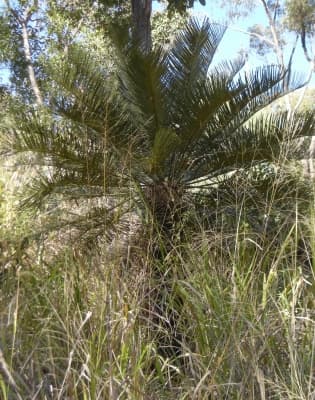
Macrozamia miquelii
Macrozamia miquelii
Safety & Hazards
The raw seed is toxic and requires treatment prior to eating it[1]. We have no further specific information for this species, but most if not all members of this genus are believed to contain toxins. The two main toxic compounds that have been identified are cycasin and macrozamin. When ingested in sufficient quantities, these compounds are extremely poisonous to humans and many other animals, and have been shown to cause liver damage and cancer. Cycasin and macrozamin have a cumulative effect upon the body and are suspected of causing neurological disorders when ingested in small amounts over long periods of time. There is a long history of human use of this genus as a starch-rich food, but it should be noted that the plants needed to be treated in various ways in order to remove any toxic principles. Caution should be exercised even with properly prepared foods, since even then regular consumption may lead to severe health problems and death. Since many of these species are becoming increasingly rare in the wild, this is probably a food best left to times of food shortage when other, better foods, are not available[2, PFAF].
Cultivation Details
Macrozamia miquelii is a plant mainly of lowland subtropical climates. It grows in a region where the temperatures are in the range 22 - 32°c in the summer, and 10 - 24°c in the winter Mean annual rainfall is within the range 900 - 1,350mm[2]. An easy plant to grow, accepting full sun and partial shade[3]. Requires a well-drained soil[4]. Succeeds in the wild in a wide range of soils and situations, from rich peat to grit; in soils from almost swampy to dry rocks; and in shade as well as full sun[5]. A slow-growing species[4]. This is a restricted species in Queensland and, as such, a license is required to harvest, propagate trade or deal with it in any way[4]. Cycad species can usually be transplanted easily even when quite large. The best time for moving them is just before the beginning of a new growing season, the roots being trimmed if they are damaged and perhaps some leaves being removed. New roots should develop quickly as the season progresses[2]. Species in this genus form structures known as coralloid roots. These roots branch off from the taproot or secondary roots and are distinctive in that they grow laterally or upward, forming a nodular mass at the apex. These coralloid roots occur slightly below or slightly above the soil surface and generally contain cyanobacteria, also known as blue-green algae. These are able to fix atmospheric nitrogen and make it available as a nutrient to the plant. The ability to extract this important nutrient from the air explains how many cycad species are able to survive on almost sterile soils[2]. A dioecious species, with individual plants producing either all male or all female cones. Therefore both male and female forms of the plant need to be grown if seed is required[2]. On very rare occasions, usually when a plant has been under severe stress, it can change sex and produce either all female or all male cones[2].
Propagation
Seed - it is easy to germinate from fresh seed, though it might take 2 years to do so[4]. Cite as: Tropical Plants Database, Ken Fern. tropical.theferns.info. 2026-02-20. <tropical.theferns.info/viewtropical.php?id=Macrozamia+miquelii>
Pollinators
Insects
References
- [1]Dictionary of Economic Plants. — Uphof. J. C. Th. · Weinheim · 1959 · ISBN - ↩︎An excellent and very comprehensive guide but it only gives very short descriptions of the uses without any details of how to utilize the plants. Not for the casual reader.
- [2]The Cycads — Whitelock L.M. · Timber Press; Portland, Oregon · 2002 · ISBN 0-88192-522-5 ↩︎An excellent book dealing with the eleven different genera and almost 300 species of plants we know as Cycads. There are detailed descriptions and a host of other information for each species.
- [3]Palm and Cycad Societies of Australia. — http://www.pacsoa.org.au/ ↩︎Contains at least a little information on the majority of palm and cycad species, plus a wealth of photographs. A first class website.
- [4]Brisbane Rainforest Action and Information Network, — http://www.brisrain.webcentral.com.au ↩︎Information on plants in the Queensland Rainforests.
- [5]Bihrmann's Caudiciforms — http://www.bihrmann.com/caudiciforms/ ↩︎An internet site giving information on caudiciform plants (plants with swollen stem bases such as the Baobab tree, cycads and many succulents). Excellent photos, usually of cultivated plants in pots.
- [6]Flora of Australia — http://www.anbg.gov.au/abrs/abif/flora/ ↩︎The full information from the Flora of Australia - on-line. An excellent resource.
- [7]IUCN Red List of Threatened Species — http://www.iucnredlist.org/ ↩︎A list of plants under threat and facing possible extinction, usually with brief details of the threats and information on habitat.
- [8]Wild Food Plants of Australia. — Low. T. · Angus and Robertson. · 1989 · ISBN 0-207-14383-8 ↩︎Well presented, clear information and good photographs. An interesting read for the casual reader as well as the enthusiast
- [9]The Useful Native Plants of Australia. — Maiden J.H. · Turner & Co.; London. · 1889 · http://www.biodiversitylibrary.org ↩︎Terse details of the uses of many Australian plants and other species naturalised, or at least growing, in Australia. It can be downloaded from the Internet.
- [10]Useful Wild Plants in Australia. — Cribb. A. B. and J. W. · William Collins Pty Ltd. Sidney · 1981 · ISBN 0-00-216441-8 ↩︎A very readable book.
- [11]Economic Botany of the Cycads — Thieret J.W. · 1958 · https://doi.org/10.1007/BF02863122 ↩︎
- [PFAF]Plants for a Future — pfaf.org ↩︎