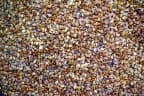
Macrotyloma uniflorum
Macrotyloma uniflorum
Safety & Hazards
The seeds contain antinutritional compounds such as lectins, trypsin inhibitors, phytates, tannins and oxalic acid. They need to be thoroughly cooked or fermented before being eaten[1].
Cultivation Details
A plant of the tropics and subtropics, where it is found at elevations up to 1,800 metres. It grows best in areas where annual daytime temperatures are within the range 20 - 28°c, but can tolerate 17 - 35°c[2]. It is completely intolerant of frost[3]. It prefers a mean annual rainfall in the range 500 - 1,200mm, but tolerates 300, 4,300mm[2]. Grows best in a sunny position[2]. The plant is adapted to a wide range of well-drained soils, from sands and gravels to clay loams and heavy clays[3]. It succeeds in most soils, including those low in nutrients[2]. Prefers a pH in the range 5.5 - 7, tolerating 5 - 8[2]. Established plants are very drought tolerant[3, 2]. Plants take 120 - 180 days to mature a seed crop[2]. In India average seed yields vary from 200 - 900 kg/ha, whilst in Australia yields of 1,100 - 2,300 kg/ha have been achieved[2]. Fresh matter production may be 18 - 30 tonnes per hectare[2]. This species has a symbiotic relationship with certain soil bacteria, these bacteria form nodules on the roots and fix atmospheric nitrogen. Some of this nitrogen is utilized by the growing plant but some can also be used by other plants growing nearby[1].
References
- [1]Protabase - Plant Resources of Tropical Africa. — http://www.prota.org ↩︎An excellent on-line database with detailed information on over 3,200 species of useful plants of Africa.
- [2]Ecocrop — http://ecocrop.fao.org/ecocrop/srv/en/home ↩︎Basic information on a wide range of useful plants, plus details of environmental needs where available.
- [3]Tropical Forages — http://www.tropicalforages.info/key/Forages/Media/Html/index.htm ↩︎Mainly focussed on forage plants, the site gives a lot of information on the plant, with a good botanical description, details of cultivation, plant uses and a good selection of photographs.
- [4]Mansfeld's Database of Agricultural and Horticultural Plants — http://mansfeld.ipk-gatersleben.de/pls/htmldb_pgrc/f?p=185:3:4292127278597336 ↩︎Terse details of a huge range of useful plants.
- [5]Flora of China — Missouri Botanical Garden Press; St. Louis. · 1994 · http://flora.huh.harvard.edu/china/ ↩︎An excellent, comprehensive resource in 25 volumes. In addition to the botanical information the flora also gives basic information on habitat and some uses. An on-line version is also available.
- [6]Plant Resources of Southeast Asia — http://proseanet.org/ ↩︎Lots of information on the uses of the plants of SE Asia.