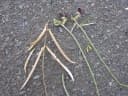
Macroptilium atropurpureum
Macroptilium atropurpureum
Safety & Hazards
None known
Cultivation Details
The plant grows well from the subtropics with fairly cold winters to the seasonal tropics, succeeding in semi-arid areas but not doing so well in humid areas; it can be found at elevations up to 2,900 metres. It grows best in areas where annual daytime temperatures are within the range 21 - 32°c, but can tolerate 13 - 36°c[1]. When dormant, the root system can survive temperatures down to about -8°c, but young growth can be severely damaged at -1°c[1]. It prefers a mean annual rainfall in the range 650 - 1,800mm, but tolerates 200 - 2,800mm[1]. Requires a sunny position for best growth, tolerating light shade[1]. Tolerant of a range of well-drained soils, other than heavy clays,and growing well in soils of moderate fertility and tolerating poor fertility[1, 2]. Succeeds in dry soils and very tolerant of drought once established[3, 1]. Prefers a pH in the range 6 - 7.5, tolerating 4.5 - 8.5[1]. Plants grow vigorously from seed - in weeded beds they can flower and produce seed in their first year, but when grown amongst other plants they usually take longer[4]. The plant generally lives from 1 - 10 years[4]. This species has a symbiotic relationship with certain soil bacteria; these bacteria form nodules on the roots and fix atmospheric nitrogen. Some of this nitrogen is utilized by the growing plant but some can also be used by other plants growing nearby[3].
Propagation
Seed - it has a somewhat hard seedcoat and may benefit from scarification before sowing in order to speed up and improve germination. This can usually be done by pouring a small amount of nearly boiling water on the seeds (being careful not to cook them!) and then soaking them for 12 - 24 hours in warm water. By this time they should have imbibed moisture and swollen - if they have not, then carefully make a nick in the seedcoat (being careful not to damage the embryo) and soak for a further 12 hours before sowing. Seed is generally sown in situ. Cite as: Tropical Plants Database, Ken Fern. tropical.theferns.info. 2026-02-20. <tropical.theferns.info/viewtropical.php?id=Macroptilium+atropurpureum>
Pollinators
Self, Insects
References
- [1]Ecocrop — http://ecocrop.fao.org/ecocrop/srv/en/home ↩︎Basic information on a wide range of useful plants, plus details of environmental needs where available.
- [2]Australian Tropical Rainforest Plants — http://www.anbg.gov.au/cpbr/cd-keys/rfk/index.html ↩︎An online resource giving botanical information, and a little bit about plant usage, for over 2,700 species of plants found in the Australian rainforest.
- [3]Grassland Species - Profiles — http://www.fao.org/ag/AGP/AGPC/doc/Gbase/Default.htm ↩︎Terse information on over 650 species of plants that grow in grassland, including trees, shrubs and perennial plants as well as grasses. Gives a brief description of the plant, its range and habitat and some of its uses.
- [4]Plant Resources of Southeast Asia — http://proseanet.org/ ↩︎Lots of information on the uses of the plants of SE Asia.
- [5]Flora of Guatemala — Standley P.C. & J. A. Steyermark · 1946 - 1976 · http://www.archive.org/ ↩︎A superb reference, though somewhat dated. Gives lots of plant uses as well as information on plant habit and habitat. The entire flora (13 volumes) can now be downloaded from http://www.archive.org/