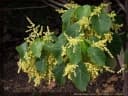
Macaranga tanarius
Macaranga tanarius
Safety & Hazards
None known
Cultivation Details
A plant of the tropics and subtropics, where it is found at elevations up to 2,100 metres. It grows best in areas where annual daytime temperatures are within the range 20 - 30°c, but can tolerate 15 - 35°c[1]. When dormant, the plant can survive temperatures down to about 1°c[1]. It prefers a mean annual rainfall in the range 800 - 1,200mm, but tolerates 700 - 1,300mm[1]. The plant is found growing in Australia in areas with a mean annual rainfall in the range 950 - 4,000mm, with a distinct dry season[2]. Prefers a sunny position[2]. Grows in the wild on clay loam, sandy, and sandstone soils[3]. Prefers a well-drained soil[2]. Plants are tolerant of moderate levels of salt in the soil[2]. Prefers a pH in the range 5.5 - 7, tolerating 5 - 7.5[1]. Tolerant of salt-laden coastal winds[2]. The plant has escaped from cultivation in some areas where it is cultivated[4]. It has been classed as 'invasive' in Hawaii[4]. A fast-growing but short-lived tree, seldom surviving beyond 15 years[1, 2]. Plants respond very well to coppicing and pollarding[2]. A dioecious species, both male and female forms need to be grown if seed is required[3].
Propagation
Seed - when sown with the adhering pulp, the seed have a germination rate of about 50% in 24 - 72 (max. 265) days[5, 2]. Seed viability is reputed to be poor in ambient conditions[2]. Cite as: Tropical Plants Database, Ken Fern. tropical.theferns.info. 2026-02-20. <tropical.theferns.info/viewtropical.php?id=Macaranga+tanarius>
Pollinators
Wind
References
- [1]Ecocrop — http://ecocrop.fao.org/ecocrop/srv/en/home ↩︎Basic information on a wide range of useful plants, plus details of environmental needs where available.
- [2]Florabank Fact Sheets — http://www.florabank.org.au/lucid/key/Species%20Navigator/Media/Html/index.htm#D ↩︎An excellent on-line publication. At present their are 132 species in the list, giving lots of information on growing and using the plants, plus information on their climatic tolerances, distribution maps and photographs.
- [3]Euphorbiaceae of Malesia — http://www.nationaalherbarium.nl/euphorbs/ ↩︎An online resource that is still being developed, it gives detailed botanical descriptions of plants in the family Euphorbiaceae found growing in Malesia (the region from Peninsual Malaysia through Indonesia, the Philippines).
- [4]Pacific Island Ecosystems at Risk — http://www.hear.org/pier/scientificnames/index.html ↩︎A very good website detailing weed species that have been introduced into the Pacific Islands.
- [5]World Agroforesty Centre — http://www.worldagroforestry.org/ ↩︎An excellent online database of a huge range of trees giving very good information on each plant - its uses, ecology, identity, propagation, pests etc.
- [6]Flora of China — Missouri Botanical Garden Press; St. Louis. · 1994 · http://flora.huh.harvard.edu/china/ ↩︎An excellent, comprehensive resource in 25 volumes. In addition to the botanical information the flora also gives basic information on habitat and some uses. An on-line version is also available.
- [7]Minor Products of Philippine Forests — Brown. W. H. · Bureau of Forestry, Manilla. · 1920 ↩︎A useful guide to some of the plants of the area, though terse on details. The book is out of copyright and can be legally downloaded from the Internet.
- [8]Australian Tropical Rainforest Plants — http://www.anbg.gov.au/cpbr/cd-keys/rfk/index.html ↩︎An online resource giving botanical information, and a little bit about plant usage, for over 2,700 species of plants found in the Australian rainforest.
- [9]IUCN Red List of Threatened Species — http://www.iucnredlist.org/ ↩︎A list of plants under threat and facing possible extinction, usually with brief details of the threats and information on habitat.
- [10]Plant Resources of Southeast Asia — http://proseanet.org/ ↩︎Lots of information on the uses of the plants of SE Asia.
- [11]Cornucopia II — Facciola. S. · Kampong Publications, California. · 1998 · ISBN 0-9628087-2-5 ↩︎The second edition of an excellent guide to the edible uses of plants, though it does not give any details of cultivation etc.
- [12]Philippine Medicinal Plants — http://www.stuartxchange.org/CompleteList.html ↩︎A lovely site, giving brief details on the medicinal uses of several hundred (over 400 at the last count) plants in the Philippines, plus a picture of each plant.