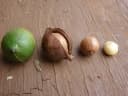
Macadamia integrifolia
Macadamia integrifolia
Safety & Hazards
None known
Cultivation Details
Macadamia integrifolia is a plant of the subtropics and tropics of eastern Australia. Iit has fairly stringent environmental needs if good crops of seeds are to be produced[1]. In the tropics it fruits best at elevations from 1,000 - 1,600 metres, but succeeds down to sea level in the subtropics[2]. It grows best in areas where annual daytime temperatures are within the range 10 - 26°c, but can tolerate 8 - 35°c[2]. Mature plants are capable of withstanding mild frosts, but only for short periods[1]. It prefers a mean annual rainfall in the range 1,000 - 3,000mm, but tolerates 700 - 3,500mm[2]. Requires a sunny position[2]. Plants grow best in rich, moist but well-drained soils and require copious summer watering in their early stages[3, 1]. Prefers a pH in the range 5 - 6, tolerating 4.5 - 7[2]. Established plants are very drought resistant[4]. Trees require a sheltered position and are easily damaged by strong winds[4]. Floral initiation takes place when temperatures drop and trees become quiescent in autumn, the optimum temperature being 18°c[1]. The initials remain dormant for 50 - 96 days; the racemes extend after a rise in temperature and some rain[1]. Seedling growth is initially slow, but gathers momentum as saplings produce a series of extension growth flushes in a year[1]. The juvenile phase lasts for 7 years or more, but grafted trees come into bearing after 3 years[1]. Plants are slow growing in cultivation, especially when young, seedlings take 6 - 7 years to produce their first fruit[3, 1]. The trees then produce commercial crops for about 40 - 50 years and can fruit for up to 100 years[4]. The trees can flower and produce fruit all year round[5]. Yields of 45 kg nuts-in-shell from better trees or an average of 3.2 - 3.5 t/ha per year are obtained in Hawaii[1]. Pruning is not normally necessary, but is tolerated if carried out in the autumn[6]. There are some named varieties[3, 7].
Propagation
Seed - best sown as soon as it is ripe in a warm greenhouse[6]. The dehusked seed germinates quickly at 25°c[4]. The seed can also be sown in the spring in a warm greenhouse[6]. When they are large enough to handle, prick the seedlings out into individual pots and grow them on in the greenhouse for at least their first winter. Plant them out into their permanent positions in late spring or early summer, after the last expected frosts. If trying them outdoors, give the plants some protection from the cold for their first few winters. Cultivars may be grafted. Cite as: Temperate Plants Database, Ken Fern. temperate.theferns.info. 2026-02-21. <temperate.theferns.info/plant/Macadamia+integrifolia>
Pollinators
Bees
References
- [1]World Agroforesty Centre — http://www.worldagroforestry.org/ ↩︎An excellent online database of a huge range of trees giving very good information on each plant - its uses, ecology, identity, propagation, pests etc.
- [2]Ecocrop — http://ecocrop.fao.org/ecocrop/srv/en/home ↩︎Basic information on a wide range of useful plants, plus details of environmental needs where available.
- [3]A Field Guide to Australian Trees. — Holliday. I. and Hill. R. · Frederick Muller Ltd. · 1974 · ISBN 0-85179-627-3 ↩︎A well illustrated and very readable book, but it does not contain much information for the plant project.
- [4]The New RHS Dictionary of Gardening. 1992. — Huxley. A. · MacMillan Press · 1992 · ISBN 0-333-47494-5 ↩︎Excellent and very comprehensive, though it contains a number of silly mistakes. Readable yet also very detailed.
- [5]Edible Nuts. — Wickens G.E. · FAO, Rome. · 1995 · http://www.fao.org/docrep/ · ISBN 92-5-103748-5 ↩︎Detailed information on 20 of the most valuable nut crops, plus more basic information on a wide range of other nut-producing plants. It can be downloaded from the Internet.
- [6]The RHS Gardener's Encyclopedia of Plants and Flowers — Brickell. C. · Dorling Kindersley Publishers Ltd. · 1990 · ISBN 0-86318-386-7 ↩︎Excellent range of photographs, some cultivation details but very little information on plant uses.
- [7]Cornucopia - A Source Book of Edible Plants. — Facciola. S. · Kampong Publications · 1990 · ISBN 0-9628087-0-9 ↩︎Excellent. Contains a very wide range of conventional and unconventional food plants (including tropical) and where they can be obtained (mainly N. American nurseries but also research institutes and a lot of other nurseries from around the world.
- [8]Brazilian Fruits and Cultivated Exotics — Lorenzi. H.; Bacher. L.; Lacerda. M.; Sartori. S. · Instituto Plantarum De Estudos Da Flora LTDA; Brazil. · 2000 · ISBN 85-867174-24-0 ↩︎A superb book, giving information on several hundred fruit species. Each entry has a brief description of the plant and its uses, accompanied by one to many excellent quality photographs of the fruits.
- [9]Nuts. — Howes. F. N. · Faber · 1948 · ISBN - ↩︎Rather old but still a masterpiece. Has sections on tropical and temperate plants with edible nuts plus a section on nut plants in Britain. Very readable.
- [10]Conservatory and Indoor Plants Volumes 1 & 2 — Phillips. R. & Rix. M. · Pan Books, London. · 1998 · ISBN 0-330-37376-5 ↩︎Excellent photos of over 1,100 species and cultivars with habits and cultivation details plus a few plant uses. Many species are too tender for outdoors in Britain though there are many that can be grown outside.
- [11]Flora of Australia — http://www.anbg.gov.au/abrs/abif/flora/ ↩︎The full information from the Flora of Australia - on-line. An excellent resource.
- [12]Cornucopia II — Facciola. S. · Kampong Publications, California. · 1998 · ISBN 0-9628087-2-5 ↩︎The second edition of an excellent guide to the edible uses of plants, though it does not give any details of cultivation etc.
- [13]Tropical and Subtropical Trees - A Worldwide Encyclopaedic Guide. — Barwick. M. · Thames & Hudson, London · 2004 · ISBN 0-500-51181-0 ↩︎A superb book, very concise and well written, giving a wealth of information on 400 or more species including descriptions, habitat, cultivation details and plant uses. A wealth of colour photographs bring each plant vividly to life.