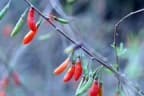
Lycium chinense
Lycium chinense
Safety & Hazards
Some caution should be exercised with this species, particularly with regard to its edible leaves, since it belongs to a family that often contains toxins. However, use of the leaves is well documented and fairly widespread in some areas.
Cultivation Details
Lycium chinense is a plant mainly of the temperate and subtropical zones, but it can be cultivated in the tropics at elevations from sea level up to 2,000 metres. It flowers profusely at low elevations, but does not flower at high elevations[1]. It grows best in areas where annual daytime temperatures are within the range 13 - 25°c, but can tolerate 8 - 32°c[1]. It is a very cold-hardy plant, tolerating temperatures down to about -23°c[2]. It prefers a mean annual rainfall in the range 700 - 1,500mm, but tolerates 300 - 2,200mm[1]. Requires a sunny position[2]. An easily grown plant, it does not require a rich soil, flowering and fruiting better in a well-drained soil of moderate quality[3, 4, 2]. Succeeds in impoverished soils[2]. Prefers a pH in the range 5.5 - 7.5, tolerating 5 - 8[1]. Tolerates maritime exposure[2].
Propagation
Seed - sow early spring in a greenhouse. Germination is usually good and fairly quick. Prick out the seedlings into individual pots when they are large enough to handle and grow them on in the greenhouse for their first winter. Plant out in late spring or early summer. Pinch out the shoot tips of the young plants in order to encourage bushy growth[5]. Cuttings of half-ripe wood, 5 - 10cm with a heel if possible, mid summer in individual pots in a frame. Good percentage[5]. Cuttings of mature wood of the current season's growth, autumn to late winter in a cold frame. High percentage[5, 2]. Division of suckers in late winter. Very easy, the suckers can be planted out direct into their permanent positions. Layering. Cite as: Temperate Plants Database, Ken Fern. temperate.theferns.info. 2026-02-21. <temperate.theferns.info/plant/Lycium+chinense>
Pollinators
Bees
References
- [1]Ecocrop — http://ecocrop.fao.org/ecocrop/srv/en/home ↩︎Basic information on a wide range of useful plants, plus details of environmental needs where available.
- [2]The New RHS Dictionary of Gardening. 1992. — Huxley. A. · MacMillan Press · 1992 · ISBN 0-333-47494-5 ↩︎Excellent and very comprehensive, though it contains a number of silly mistakes. Readable yet also very detailed.
- [3]RHS Dictionary of Plants plus Supplement. 1956 — F. Chittendon. · Oxford University Press · 1951 · ISBN - ↩︎Comprehensive listing of species and how to grow them. Somewhat outdated, it has been replaced in 1992 by a new dictionary (see [ 200 ]).
- [4]Trees and Shrubs Hardy in Great Britain. Vol 1 - 4 and Supplement. — Bean. W. · Murray · 1981 · ISBN - ↩︎A classic with a wealth of information on the plants, but poor on pictures.
- [5]Propagation of Trees, Shrubs and Conifers. — Sheat. W. G. · MacMillan and Co · 1948 · ISBN - ↩︎A bit dated but a good book on propagation techniques with specific details for a wide range of plants.
- [6]Flora of China — Missouri Botanical Garden Press; St. Louis. · 1994 · http://flora.huh.harvard.edu/china/ ↩︎An excellent, comprehensive resource in 25 volumes. In addition to the botanical information the flora also gives basic information on habitat and some uses. An on-line version is also available.
- [7]Flora of Japan. (English translation) — Ohwi. G. · Smithsonian Institution · 1965 · ISBN - ↩︎The standard work. Brilliant, but not for the casual reader.
- [8]Atlas of Medicinal Plants. — Kariyone. T. · Nihon Rinshosha; Osaka · 1973 ↩︎A good Japanese herbal.
- [9]Chinese Materia Medica. — Stuart. Rev. G. A. · Taipei. Southern Materials Centre · 1911 · ISBN - ↩︎A translation of an ancient Chinese herbal. Fascinating.
- [10]Cornucopia - A Source Book of Edible Plants. — Facciola. S. · Kampong Publications · 1990 · ISBN 0-9628087-0-9 ↩︎Excellent. Contains a very wide range of conventional and unconventional food plants (including tropical) and where they can be obtained (mainly N. American nurseries but also research institutes and a lot of other nurseries from around the world.
- [11]A Dictionary of Plants Used by Man. — Usher. G. · Constable · 1974 · ISBN 0094579202 ↩︎Forget the sexist title, this is one of the best books on the subject. Lists a very extensive range of useful plants from around the world with very brief details of the uses. Not for the casual reader.
- [12]Famine Foods listed in the Chiu-Huang Pen-ts'ao. — Reid. B. E. · Southern Materials Centre; Taipei · 1977 · ISBN - ↩︎A translation of an ancient Chinese book on edible wild foods. Fascinating.
- [13]The Encyclopedia of Medicinal Plants — Chevallier. A. · Dorling Kindersley. London · 1996 · ISBN 9-780751-303148 ↩︎An excellent guide to over 500 of the more well known medicinal herbs from around the world.
- [14]Handbook of Chinese Herbs and Formulas. — Yeung. Him-Che. · Institute of Chinese Medicine, Los Angeles · 1985 · ISBN - ↩︎An excellent Chinese herbal giving information on over 500 species. Rather technical and probably best suited to the more accomplished user of herbs.
- [15]Medicinal Plants of China — Duke. J. A. and Ayensu. E. S. · Reference Publications, Inc. · 1985 · ISBN 0-917256-20-4 ↩︎Details of over 1,200 medicinal plants of China and brief details of their uses. Often includes an analysis, or at least a list of constituents. Heavy going if you are not into the subject.
- [16]A Barefoot Doctors Manual. — ? · Running Press; Philadelphica. · 1977 · ISBN 0-914294-92-X ↩︎A very readable herbal from China, combining some modern methods with traditional chinese methods.
- [17]The New Plantsman. Volume 1, 1994. — Matthews. V. · Royal Horticultural Society · 1994 · ISBN 1352-4186 ↩︎A quarterly magazine, it has articles on Himalayacalamus hookerianus, hardy Euphorbias and an excellent article on Hippophae spp.
- [PFAF]Plants for a Future — pfaf.org ↩︎