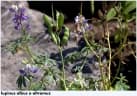
Lupinus albus
Lupinus albus
Safety & Hazards
Lupinus species in general (and especially the seeds) contain a range of bitter-tasting alkaloids such as lupine, anagyrine, sparteine and hydroxylupanine. The pharmacological effects of these alkaloids are that they block ganglionic transmission, decrease cardiac contractility and contract uterine smooth muscle[1]. When ingested in moderate to large quantities they can cause symptoms such as respiratory depression and slow heartbeat, sleepiness and convulsions[2]. Alkaloid levels can vary greatly from species to species, and several members of the genus are used for food. In some species low-alkaloid, sweeter-tasting varieties have been developed. There are also techniques (particularly soaking and discarding the soak water) that lower the alkaloid levels. Unless it is known that the plant is low in alkaloids then caution should be applied to any ingestion of the plant[PFAF]. Fungal toxins can readily invade the crushed seed and can cause chronic illness[3].
Cultivation Details
White lupin is primarily a plant of the temperate zone, though it has been successfullty cultivated in the tropics, often at higher elevations up to 3,000 metres. It is usually grown at mean monthly temperatures during the growing season of 15 - 25°c, the optimum being 18 - 24°c; higher temperatures and moisture stress hinder flowering and pod setting. The plant is cold-tolerant, but temperatures of -6 to -8°c are harmful at germination, whilst temperatures of -3 to -5°c are harmful at flowering. A rainfall of 400 - 1,000mm during the growing period is optimal for yield[1]. An easily grown plant, it requires a sunny position, but can succeed in any moderately good, well-drained soil[4, 5, 1]. It prefers a light acid soil but tolerates adverse conditions[4]. Growth is hampered on heavy clay and waterlogged soils, while calcareous or alkaline soils induce chlorosis and reduce growth, frequently precluding cultivation[1]. Prefers a pH in the range 4.5 - 7.5[1]. Lupin species are drought-tolerant due to their deep roots, but are sensitive to moisture deficiency during the reproductive period[1]. There are some named varieties, many of which have bitter seeds that contain toxic alkaloids and require leaching before they are eaten but some sweet varieties with a very low alkaloid content have also been developed[6, 1]. These sweet varieties are perfectly wholesome as food for humans and include the cultivar 'Kiev'[6]. There is some confusion between this species and Lupinus nanus[7]. A deep rooting plant[4]. This species has a symbiotic relationship with certain soil bacteria, these bacteria form nodules on the roots and fix atmospheric nitrogen. Some of this nitrogen is utilized by the growing plant but some can also be used by other plants growing nearby[5]. When removing plant remains at the end of the growing season, it is best to only remove the aerial parts of the plant, leaving the roots in the ground to decay and release their nitrogen.
Propagation
Pre-soak the seed for 24 hours in warm water and sow in mid spring in situ[7, 5]. You may need to protect the seed from mice. Germination should take place within 2 weeks. Cite as: Temperate Plants Database, Ken Fern. temperate.theferns.info. 2026-02-21. <temperate.theferns.info/plant/Lupinus+albus>
Pollinators
Bees, Self
References
- [1]Protabase - Plant Resources of Tropical Africa. — http://www.prota.org ↩︎An excellent on-line database with detailed information on over 3,200 species of useful plants of Africa.
- [2]Poisonous Plants of North Carolina — http://www.ces.ncsu.edu/depts/hort/consumer/poison/poison.htm ↩︎An excellent concise but comprehensive guide to toxic plants that grow in N. Carolina. It lists even those plants that are of very low toxicity, including several well-known food plants such as carrots and potatoes.
- [3]A Colour Atlas of Poisonous Plants. — Frohne. D. and Pfänder. J. · Wolfe · 1984 · ISBN 0723408394 ↩︎Brilliant. Goes into technical details but in a very readable way. The best work on the subject that I've come across so far.
- [4]Green Manures. — Woodward. L. Burge. P. · Elm Farm Research Centre. · 1982 · ISBN - ↩︎Green manure crops for temperate areas. Quite a lot of information on a number of species.
- [5]The New RHS Dictionary of Gardening. 1992. — Huxley. A. · MacMillan Press · 1992 · ISBN 0-333-47494-5 ↩︎Excellent and very comprehensive, though it contains a number of silly mistakes. Readable yet also very detailed.
- [6]Cornucopia - A Source Book of Edible Plants. — Facciola. S. · Kampong Publications · 1990 · ISBN 0-9628087-0-9 ↩︎Excellent. Contains a very wide range of conventional and unconventional food plants (including tropical) and where they can be obtained (mainly N. American nurseries but also research institutes and a lot of other nurseries from around the world.
- [7]RHS Dictionary of Plants plus Supplement. 1956 — F. Chittendon. · Oxford University Press · 1951 · ISBN - ↩︎Comprehensive listing of species and how to grow them. Somewhat outdated, it has been replaced in 1992 by a new dictionary (see [ 200 ]).
- [8]Mansfeld's Database of Agricultural and Horticultural Plants — http://mansfeld.ipk-gatersleben.de/pls/htmldb_pgrc/f?p=185:3:4292127278597336 ↩︎Terse details of a huge range of useful plants.
- [9]Flowers of Greece and the Balkans. — Polunin. O. · Oxford University Press · 1980 · ISBN 0-19-217626-9 ↩︎A good pocket flora, it also lists quite a few plant uses.
- [10]Flora Europaea — ? · Cambridge University Press · 1964 · ISBN - ↩︎An immense work in 6 volumes (including the index). The standard reference flora for Europe, it is very terse though and with very little extra information. Not for the casual reader.
- [11]Sturtevant's Edible Plants of the World. — Hedrick. U. P. · Dover Publications · 1972 · ISBN 0-486-20459-6 ↩︎Lots of entries, quite a lot of information in most entries and references.
- [12]Encyclopaedia of Medicinal Plants. — Chiej. R. · MacDonald · 1984 · ISBN 0-356-10541-5 ↩︎Covers plants growing in Europe. Also gives other interesting information on the plants. Good photographs.
- [13]Tanaka's Cyclopedia of Edible Plants of the World. — Tanaka. T. & Nakao S. · Keigaku Publishing; Tokyo · 1976 · ISBN - ↩︎The most comprehensive list of edible plants I've come across. Only the briefest entry for each species, though, and some of the entries are more than a little dubious. Not for the casual reader.
- [14]Fruits of the Earth. — Bianchini. F., Corbetta. F. and Pistoia. M. ↩︎Lovely pictures, a very readable book.
- [15]Wonder Crops. 1987. — Natural Food Institute, ↩︎Fascinating reading, this is an annual publication. Some reports do seem somewhat exaggerated though.
- [16]A Modern Herbal. — Grieve. · Penguin · 1984 · ISBN 0-14-046-440-9 ↩︎Not so modern (1930's?) but lots of information, mainly temperate plants.
- [17]A Dictionary of Plants Used by Man. — Usher. G. · Constable · 1974 · ISBN 0094579202 ↩︎Forget the sexist title, this is one of the best books on the subject. Lists a very extensive range of useful plants from around the world with very brief details of the uses. Not for the casual reader.
- [18]CosIng — http://ec.europa.eu/growth/tools-databases/cosing/ ↩︎CosIng is the European Commission database for information on cosmetic substances and ingredients.
- [19]Plants Database — United States Department of Agriculture · http://plants.usda.gov/java/factSheet ↩︎An online database with an excellent collection of fact sheets about native N. American plants.
- [PFAF]Plants for a Future — pfaf.org ↩︎