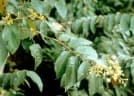
Malvaceae FAMILY
Luehea seemannii
Luehea seemannii
Edibility
0/5
Medicinal
2/5
Safety & Hazards
None known
Cultivation Details
HabitEvergreen Tree
GrowthFast
A plant of tropical lowland regions, where it can be found at elevations up to 600 metres. It grows wild in climates with a mean annual rainfall from 2,000 - 4,000mm and a mean annual temperature of 23 - 25 °c[1]. Grows wild in a wide range of soils[1]. A fast-growing tree, often flowering when still only a shrub[1]. Young plants growing in pastures and on cut-over land are often little more than shrubs and have much larger juvenile leaves, which may be nearly 30cm in length[1].
Propagation
Seed - Cite as: Tropical Plants Database, Ken Fern. tropical.theferns.info. 2026-02-20. <tropical.theferns.info/viewtropical.php?id=Luehea+seemannii>
Pollinators
Data unavailable
References
- [1]Tropical Tree Seed Manual — Vosso. J. Editor. · USDA Forest Service. · 2002 · http://www.rngr.net/Publications/ttsm ↩︎An extremely good guide, it can also be downloaded in its entirety from the address shown above.
- [2]Tropical Timbers of the World. Ag. Handbook No. 607. — Chudnoff. Martin. · USDA Forest Service. Wisconsin. · 1984 ↩︎Terse details on the properties of the wood of almost 400 species of trees from the Tropics.
- [3]Flora of Guatemala — Standley P.C. & J. A. Steyermark · 1946 - 1976 · http://www.archive.org/ ↩︎A superb reference, though somewhat dated. Gives lots of plant uses as well as information on plant habit and habitat. The entire flora (13 volumes) can now be downloaded from http://www.archive.org/
- [4]Flora of the Lancetilla Valley, Honduras. — Standley P.C. · Field Museum of Natural History; Chicago. · 1931 · http://www.biodiversitylibrary.org ↩︎Rather short on details at times, which is not surprising since so little information was available at the time. Still a useful flora. It can be downloaded from the Internet.
- [5]Contributions from the United States National Herbarium Vol. 27 — Standley P.C. · Smithsonian Institute; Washington. · 1928 · http://www.biodiversitylibrary.org ↩︎Contains a Flora of the Panama Canal zone
- [6]Journal of Ethnobiology Vol 17 — Eugene S. Hunn (Editor) · Society of Ethnobiology; Seattle. · 1997 - 1998 ↩︎A series of articles on the various ways humans use plants. It can be downloaded from the Internet.