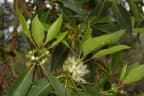
Lophostemon confertus
Lophostemon confertus
Safety & Hazards
None known
Cultivation Details
A plant of the subtropics to the tropics, where it is found at elevations up to 800 metres. It grows best in areas where annual daytime temperatures are within the range 18 0 28°c, but can tolerate 10 - 36°c[1]. When dormant, the plant can survive temperatures down to about -5°c, but young growth can be severely damaged at -1°c[1]. It prefers a mean annual rainfall in the range 1,100 - 1,500mm, but tolerates 900 - 1,700mm[1]. Succeeds in full sun to partial shade[2]. Requires a well-drained, fertile soil[2]. Succeeds in sandy to clayey soils[1]. Prefers a pH in the range 5 - 6.5, tolerating 4.5 - 7[1]. The tree has escaped from cultivation in Hawaii and become invasive[3]. Very tolerant of hard and repeated pruning[4].
Propagation
Seed - very small, it is best mixed with fine sand when sowing. It germinates easily. Cite as: Tropical Plants Database, Ken Fern. tropical.theferns.info. 2026-02-20. <tropical.theferns.info/viewtropical.php?id=Lophostemon+confertus>
Pollinators
Bees
References
- [1]Ecocrop — http://ecocrop.fao.org/ecocrop/srv/en/home ↩︎Basic information on a wide range of useful plants, plus details of environmental needs where available.
- [2]Desert Tropicals — http://www.desert-tropicals.com/ ↩︎The main focus of the site is succulent plants, but it also contains information on a wide range of other species. Usually at least one good photograph, plus basic information about the plant and its cultivation.
- [3]Pacific Island Ecosystems at Risk — http://www.hear.org/pier/scientificnames/index.html ↩︎A very good website detailing weed species that have been introduced into the Pacific Islands.
- [4]The New RHS Dictionary of Gardening. 1992. — Huxley. A. · MacMillan Press · 1992 · ISBN 0-333-47494-5 ↩︎Excellent and very comprehensive, though it contains a number of silly mistakes. Readable yet also very detailed.
- [5]Inventory of Seeds and Plants Imported Vol. 49 — USDA; Washington · 1921 · http://www.biodiversitylibrary.org ↩︎Details of seeds and plants imported for trials by the United States Department of Agriculture in the last quarter of 1916, often detailing the uses of the plant and various other miscellaneous information. It can be downloaded from the Internet.
- [6]The Useful Native Plants of Australia. — Maiden J.H. · Turner & Co.; London. · 1889 · http://www.biodiversitylibrary.org ↩︎Terse details of the uses of many Australian plants and other species naturalised, or at least growing, in Australia. It can be downloaded from the Internet.
- [7]Australian Rainforest Plants Volumes 1 - 6 — Nicholson N. & H. · Terania Rainforest Publishing; New South Wales. · 2007 · ISBN 9-78095894-3628 ↩︎Beautiful set of booklets with a terse description of over 600 species and their habitat, often including some of their uses and notes on their cultivation, plus at least one, excellent photograph.
- [8]Useful Wild Plants in Australia. — Cribb. A. B. and J. W. · William Collins Pty Ltd. Sidney · 1981 · ISBN 0-00-216441-8 ↩︎A very readable book.
- [9]Dictionary of Economic Plants. — Uphof. J. C. Th. · Weinheim · 1959 · ISBN - ↩︎An excellent and very comprehensive guide but it only gives very short descriptions of the uses without any details of how to utilize the plants. Not for the casual reader.