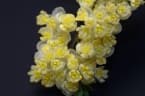
Litsea cubeba
Litsea cubeba
Safety & Hazards
None known
Cultivation Details
Litsea cubeba has a wide range, from southern central China to Indonesia. Whilst most of this is tropical by nature, the plant extends far enough northwards in China (Henan and Jiangsu, hardiness zone 8) as to reach the warm temperate zone. Whilst it is unlikely to be very frost tolerant, it should be worthwhile trying outdoors in other warm areas of the temperate zone. It has succeeded in the Pacific Northwest of the USA and also in Cornwall, southwest England, where it is said to be fast-growing[1]. A fast-growing tree[2]. Trees produced from cuttings can commence bearing fruit when just 2 - 3 years old[3]. All parts of the plant have a pleasant, lemon-like aroma[4, 5]. A dioecious species, both male and female forms need to be grown if seed is required[5]. There are also forms of the plant with functioning hermaphrodite flowers[6].
Propagation
Seed - Cite as: Temperate Plants Database, Ken Fern. temperate.theferns.info. 2026-02-21. <temperate.theferns.info/plant/Litsea+cubeba>
Pollinators
Data unavailable
References
- [1]New Trees — Grimshaw J.; Bayton R.; Wilks H. · Kew Publishing; London · 2009 · ISBN 1842461737 ↩︎Provides comprehensive botanical descriptions and horticultural commentary on over 800 tree species that have been introduced to cultivation in recent decades.
- [2]Forest Restoration Planting in Northern Thailand — Pakkad G.; Elliott S.; Anusarnsunthorn V. Et al · Food and Agriculture Organization of the United Nations; Bangkok · 2002 · http://www.fao.org/ ↩︎A report on reforestation in northern Thailand by using specific pioneer species. It can be downloaded from the Internet.
- [3]Plant Resources of Southeast Asia — http://proseanet.org/ ↩︎Lots of information on the uses of the plants of SE Asia.
- [4]Cornucopia II — Facciola. S. · Kampong Publications, California. · 1998 · ISBN 0-9628087-2-5 ↩︎The second edition of an excellent guide to the edible uses of plants, though it does not give any details of cultivation etc.
- [5]Biotik, Laos — http://biotik.org/species_list_laos.html ↩︎Information on more than 100 species of Laotian trees.
- [6]The Gardens' Bulletin Vol. 57 — National Parks Board; Singapore · 2005 · http://www.biodiversitylibrary.org · ISBN 0374-7859 ↩︎A botanical publication containing a range of articles including one of the genera Lindera, Litsea and Neolitsea. It can be downloaded from the Internet.
- [7]Flora of China — Missouri Botanical Garden Press; St. Louis. · 1994 · http://flora.huh.harvard.edu/china/ ↩︎An excellent, comprehensive resource in 25 volumes. In addition to the botanical information the flora also gives basic information on habitat and some uses. An on-line version is also available.
- [8]Mansfeld's Database of Agricultural and Horticultural Plants — http://mansfeld.ipk-gatersleben.de/pls/htmldb_pgrc/f?p=185:3:4292127278597336 ↩︎Terse details of a huge range of useful plants.
- [9]Thai Forest Bulletin (Botany) No. 39 — Thawatchai Santisuk (Editor) · The Forest Herbarium (BKF); Chatuchak, Bangkok. · 2011 · ISBN 0495-3843 ↩︎A botanical journal, publishing papers on taxonomy (especially vascular plants), nomenclature, phylogeny, systematics, plant geography, and floristics; also morphology, palynology, cytotaxonomy, chemotaxonomy, anatomy and other relevant disciplines.
- [10]CosIng — http://ec.europa.eu/growth/tools-databases/cosing/ ↩︎CosIng is the European Commission database for information on cosmetic substances and ingredients.
- [PFAF]Plants for a Future — pfaf.org ↩︎