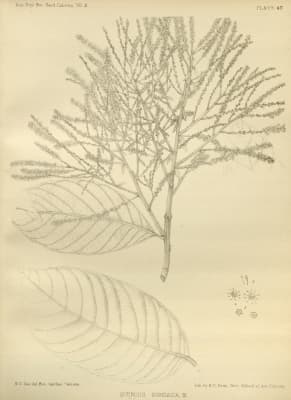
Lithocarpus sundaicus
Lithocarpus sundaicus
Safety & Hazards
None known
Cultivation Details
Lithocarpus sundaicus is a plant of the moist tropics, where it is usually found at elevations up to 1,500 metres, exceptionally to 2,600 metres[1]. The genus as a whole usually grows in areas with year-round rainfall, disliking dry seasons. Young plants usually grow sucessfully in the shade of woodland, but older trees like a more sunny position. Lithocarpus species are mainly found in well-drained soils, often growing on slopes; they tend to be tolerant of a range of soil textures and to prefer an acid to neutral pH. In experimental plantations in Java it was found that the bark of trees as young as 5 years already contained large amounts of tannin (16.5 - 22% on a dry weight basis). A tree 8 metres tall, with a trunk diameter at breast height of 12 cm, has an average yield of 3.5 kg dry bark. The bark can easily be removed from the trunk[2].
Propagation
Seed - it quickly loses viability if it is allowed to dry out. It can be stored moist and cool, but is best sown as soon as it is ripe in an outdoor seed bed, though it must be protected from mice, squirrels etc. Small quantities of seed can be sown in deep pots in a cold frame. Plants produce a deep taproot and need to be planted out into their permanent positions as soon as possible, in fact seed sown in situ will produce the best trees[3]. Trees should not be left in a nursery bed for more than 2 growing seasons without being moved or they will transplant very badly. Cite as: Tropical Plants Database, Ken Fern. tropical.theferns.info. 2026-02-20. <tropical.theferns.info/viewtropical.php?id=Lithocarpus+sundaicus>
Pollinators
Insects, Wind
References
- [1]Flora Malesiana Series 1 — Various · Nationaal Herbarium Nederiand, Universiteit Leiden branch · http://www.archive.org ↩︎A massive treatment of the plants of the Malaysian Archipelago. Much of it has been made available to download from the Internet
- [2]Plant Resources of Southeast Asia — http://proseanet.org/ ↩︎Lots of information on the uses of the plants of SE Asia.
- [3]Trees and Shrubs Hardy in Great Britain. Vol 1 - 4 and Supplement. — Bean. W. · Murray · 1981 · ISBN - ↩︎A classic with a wealth of information on the plants, but poor on pictures.
- [4]A Dictionary of Malaysian Timbers — Wong T.M. · Forest Research Institute Malaysia; Kuala Lumpur · 2002 · http://Elaeocarpaceae · ISBN 983-2181-29-1 ↩︎A fairly comprehensive guide to Malaysian timbers, giving their properties and the main tree species from which they are obtained.
- [5]Tree Flora of Sabah and Sarawak Vols 1 - 6 — Soepadmo E.; Saw L.G.; Chung R.C.K. (Editors) · Forest Research Institute Malaysia; Kuala Lumpur. · 2002 · ISBN 983-2181-27-5 ↩︎A flora of the woody plants of Sabah and Sarawak on the island of Borneo, often giving details of plant uses.
- [6]Dictionary of Economic Plants. — Uphof. J. C. Th. · Weinheim · 1959 · ISBN - ↩︎An excellent and very comprehensive guide but it only gives very short descriptions of the uses without any details of how to utilize the plants. Not for the casual reader.
- [PFAF]Plants for a Future — pfaf.org ↩︎