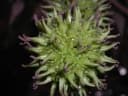
Liquidambar styraciflua
Liquidambar styraciflua
Safety & Hazards
None known
Cultivation Details
Liquidambar styraciflua is a tree with a wide environmental range, being found as far north as Connecticut in N. America and south to El Salvador and Honduras in Central America. It is mainly, but not exclusively, found at elevations above 1,000 metres in the south of its range, but with some specimens succeeding down to 450 metres. It grows best in areas where annual daytime temperatures are within the range 20 - 34°c, but can tolerate 5 - 38°c[1]. When dormant, the plant can survive temperatures down to about -11°c, but young growth can be severely damaged at -1°c[1]. It prefers a mean annual rainfall in the range 1,000 - 1,500mm, but tolerates 800 - 2,500mm[1]. Prefers a moist but not swampy loam in a sunny sheltered position[2, 3]. Another report says that the plant can tolerate salt-laden winds[1]. Succeeds in light shade[4]. Prefers a neutral to acid soil[5]. Plants grow poorly in shallow soils overlying chalk[4]. Prefers a pH in the range 5 - 7, tolerating 4.5 - 8.5[1]. Trees commence flowering when about 20 - 25 years old[6]. Trees are not very resistant to forest fires[1]. The leaves emit a balsam-like fragrance when they fall in the autumn, this is retained until the leaves are quite withered[7]. Plants in the north of their range do not produce much resin[8], yields being best in Central America[9]. Resists honey fungus[10]. This species resents root disturbance, young plants should be pot-grown and be placed in their permanent positions as soon as possible[3].
Propagation
Seed - best sown as soon as it is ripe in the autumn in a cold frame. Harvest the seed capsules at the end of early autumn or late autumn, dry in a warm place and extract the seed by shaking the capsule. Stored seed requires 1 - 3 months stratification and sometimes takes 2 years to germinate. Sow it as early in the year as possible. Germination rates are often poor. Prick out the seedlings into individual pots when they are large enough to handle and grow them on in a cold frame or greenhouse for their first winter. Since they resent root disturbance, it is best to plant them out into their permanent positions in early summer of their second year and give them some protection from cold for their first winter outdoors[PFAF]. Cuttings of half-ripe wood, mid summer in a frame. Suckers in early spring. Layering in autumn. Takes 12 months. Cite as: Temperate Plants Database, Ken Fern. temperate.theferns.info. 2026-02-21. <temperate.theferns.info/plant/Liquidambar+styraciflua>
Pollinators
Bees
References
- [1]Ecocrop — http://ecocrop.fao.org/ecocrop/srv/en/home ↩︎Basic information on a wide range of useful plants, plus details of environmental needs where available.
- [2]Trees and Shrubs Hardy in Great Britain. Vol 1 - 4 and Supplement. — Bean. W. · Murray · 1981 · ISBN - ↩︎A classic with a wealth of information on the plants, but poor on pictures.
- [3]The New RHS Dictionary of Gardening. 1992. — Huxley. A. · MacMillan Press · 1992 · ISBN 0-333-47494-5 ↩︎Excellent and very comprehensive, though it contains a number of silly mistakes. Readable yet also very detailed.
- [4]The RHS Gardener's Encyclopedia of Plants and Flowers — Brickell. C. · Dorling Kindersley Publishers Ltd. · 1990 · ISBN 0-86318-386-7 ↩︎Excellent range of photographs, some cultivation details but very little information on plant uses.
- [5]The Plantsman. Vol. 4. 1982 - 1983. — ? · Royal Horticultural Society · 1982 · ISBN - ↩︎Excerpts from the periodical giving cultivation details and other notes on some of the useful plants, including Distylium racemosum and some perennial members of the family Berberidaceae.
- [6]The Complete Trees of N. America. Field Guide and Natural History. — Elias. T. · Van Nostrand Reinhold Co. · 1980 · ISBN 0442238622 ↩︎A very good concise guide. Gives habitats, good descriptions, maps showing distribution and a few of the uses. It also includes the many shrubs that occasionally reach tree proportions.
- [7]Scented Flora of the World. — Genders. R. · Robert Hale. London. · 1994 · ISBN 0-7090-5440-8 ↩︎An excellent, comprehensive book on scented plants giving a few other plant uses and brief cultivation details. There are no illustrations.
- [8]Cornucopia - A Source Book of Edible Plants. — Facciola. S. · Kampong Publications · 1990 · ISBN 0-9628087-0-9 ↩︎Excellent. Contains a very wide range of conventional and unconventional food plants (including tropical) and where they can be obtained (mainly N. American nurseries but also research institutes and a lot of other nurseries from around the world.
- [9]Flora of Guatemala — Standley P.C. & J. A. Steyermark · 1946 - 1976 · http://www.archive.org/ ↩︎A superb reference, though somewhat dated. Gives lots of plant uses as well as information on plant habit and habitat. The entire flora (13 volumes) can now be downloaded from http://www.archive.org/
- [10]The Garden. Volume 112. — RHS. · Royal Horticultural Society · 1987 · ISBN - ↩︎Snippets of information from the magazine of the RHS. In particular, there are articles on plants that are resistant to honey fungus, oriental vegetables, Cimicifuga spp, Passiflora species and Cucurbits.
- [11]RHS Dictionary of Plants plus Supplement. 1956 — F. Chittendon. · Oxford University Press · 1951 · ISBN - ↩︎Comprehensive listing of species and how to grow them. Somewhat outdated, it has been replaced in 1992 by a new dictionary (see [ 200 ]).
- [12]Trees of North Texas — Vines. R.A. · University of Texas Press. · 1982 · ISBN 0292780206 ↩︎A readable guide to the area, it contains descriptions of the plants and their habitats with quite a bit of information on plant uses.
- [13]Gray's Manual of Botany.Eighth Edition — Fernald. M. L. · American Book Co.; New York · 1950 · ISBN 0442222505 ↩︎A bit dated but a good and concise flora of the eastern part of N. America.
- [14]Manual of the Trees of N. America. — Sargent. C. S. · Dover Publications Inc. New York. · 1965 · http://www.biodiversitylibrary.org/ · ISBN 0-486-20278-X ↩︎Two volumes, a comprehensive listing of N. American trees though a bit out of date now. Good details on habitats, some details on plant uses. Not really for the casual reader. It can be downloaded from the internet.
- [15]Native Harvests. — Kavasch. B. · Vintage Books · 1979 · ISBN 0-394-72811-4 ↩︎Another guide to the wild foods of America.
- [16]Tanaka's Cyclopedia of Edible Plants of the World. — Tanaka. T. & Nakao S. · Keigaku Publishing; Tokyo · 1976 · ISBN - ↩︎The most comprehensive list of edible plants I've come across. Only the briefest entry for each species, though, and some of the entries are more than a little dubious. Not for the casual reader.
- [17]Trees of Central Texas. — Vines. R. A. · University of Texas Press · 1987 · ISBN 0-292-78958-3 ↩︎A good concise guide, it gives details of habitats and some of the uses of trees growing in Texas.
- [18]Wild Food Plants of Indiana. — McPherson. A. and S. · Indiana University Press · 1977 · ISBN 0-253-28925-4 ↩︎A nice pocket guide to this region of America.
- [19]The Herb Book. — Lust. J. · Bantam books · 1983 · ISBN 0-553-23827-2 ↩︎Lots of information tightly crammed into a fairly small book.
- [20]Dictionary of Economic Plants. — Uphof. J. C. Th. · Weinheim · 1959 · ISBN - ↩︎An excellent and very comprehensive guide but it only gives very short descriptions of the uses without any details of how to utilize the plants. Not for the casual reader.
- [21]Plants for Man. — Schery. R. W. ↩︎Fairly readable but not very comprehensive. Deals with plants from around the world.
- [22]A Dictionary of Plants Used by Man. — Usher. G. · Constable · 1974 · ISBN 0094579202 ↩︎Forget the sexist title, this is one of the best books on the subject. Lists a very extensive range of useful plants from around the world with very brief details of the uses. Not for the casual reader.
- [23]Economic Botany. — Hill. A. F. · The Maple Press · 1952 · ISBN - ↩︎Not very comprehensive, but it is quite readable and goes into some detail about the plants it does cover.
- [24]Earth Medicine, Earth Food. — Weiner. M. A. · Ballantine Books · 1980 · ISBN 0-449-90589-6 ↩︎A nice book to read though it is difficult to look up individual plants since the book is divided into separate sections dealing with the different medicinal uses plus a section on edible plants. Common names are used instead of botanical.
- [25]Medicinal Plants of China — Duke. J. A. and Ayensu. E. S. · Reference Publications, Inc. · 1985 · ISBN 0-917256-20-4 ↩︎Details of over 1,200 medicinal plants of China and brief details of their uses. Often includes an analysis, or at least a list of constituents. Heavy going if you are not into the subject.
- [26]A Field Guide to Medicinal Plants. Eastern and Central N. America. — Foster. S. & Duke. J. A. · Houghton Mifflin Co. · 1990 · ISBN 0395467225 ↩︎A concise book dealing with almost 500 species. A line drawing of each plant is included plus colour photographs of about 100 species. Very good as a field guide, it only gives brief details about the plants medicinal properties.
- [27]Encyclopaedia of Herbs and their Uses. — Bown. D. · Dorling Kindersley, London. · 1995 · ISBN 0-7513-020-31 ↩︎A very well presented and informative book on herbs from around the globe. Plenty in it for both the casual reader and the serious student. Just one main quibble is the silly way of having two separate entries for each plant.
- [28]Native American Ethnobotany — Moerman. D. · Timber Press. Oregon. · 1998 · ISBN 0-88192-453-9 ↩︎Very comprehensive but terse guide to the native uses of plants. Excellent bibliography, fully referenced to each plant, giving a pathway to further information. Not for the casual reader.
- [29]Vegetable Gums and Resins. — Howes. F. N. · Faber · ISBN 81-88818-17-8 ↩︎A very good book dealing with the subject in a readable way.
- [30]Meet Flora Mexicana. — Pesman. M. W. · Dale S. King. Arizona. · 1962 · ISBN - ↩︎Very readable flora but rather lacking botanically. A few notes on useful plants.
- [31]Timber Trees of Meso America. — UNEP · 2005 · http://www.unep-wcmc.org/forest/timber/workshops/reports/MA2005/Annex%202.pdf ↩︎A PDF document, published on the internet. Detailed reports on about 30 species of timber trees from Central America.
- [PFAF]Plants for a Future — pfaf.org ↩︎