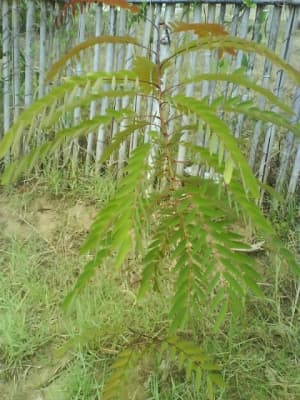
Leucaena salvadorensis
Leucaena salvadorensis
Safety & Hazards
None known
Cultivation Details
Leucaena salvadorensis is a plant of the dry to moist tropics, where it is found at elevations from 200 - 1,000 metres. It grows best in areas where annual daytime temperatures are within the range 25 - 30°c, but can tolerate 20 - 35°c[1]. It prefers a mean annual rainfall in the range 800 - 2,000mm, but tolerates 600 - 2,400mm with a dry season of 5 - 7 months[1, 2]. Prefers a sunny position[1]. Grows best in a well-drained, light to medium soil of moderate fertility[1]. The plant is found in the wild mainly on young, skeletal, shallow soils which are of volcanic origin, are freely drained and have suffered severe abuse through slash and bum agriculture, desiccation and erosion[2]. Prefers a pH in the range 6 - 7, tolerating 5.5 - 7.5[1]. Leucaena salvadorensis flowers and fruits much more shyly than most Leucaena species, and trees rarely fruit in the first year. Thereafter flowering and seed production are relatively sparse, with pods being produced singly on flower heads. This means that this is one of only five species of Leucaena that are judged to be of low weediness risk[2]. A fast-growing species[2]. When growing in agroforesty systems, the trees are sometimes managed by regular pruning in order to produce straight poles and reduce shade over crops[2]. Plants are moderately susceptible to psyllid damage[2]. This species has a symbiotic relationship with certain soil bacteria, these bacteria form nodules on the roots and fix atmospheric nitrogen. Some of this nitrogen is utilized by the growing plant but some can also be used by other plants growing nearby[3].
Propagation
Seed - unlike all other Leucaena species, the seed of this species does not need pretreatment. Seeds genninate rapidly after sowing in 3 to 7 days; a germination percentages of 70 - 80% is readily obtained for fresh seed, and there is no significant reduction in seed viability after 5 years of cold storage[3]. Cuttings of semi-ripe wood. Cite as: Tropical Plants Database, Ken Fern. tropical.theferns.info. 2026-02-20. <tropical.theferns.info/viewtropical.php?id=Leucaena+salvadorensis>
Pollinators
Bees
References
- [1]Ecocrop — http://ecocrop.fao.org/ecocrop/srv/en/home ↩︎Basic information on a wide range of useful plants, plus details of environmental needs where available.
- [2]Leucaena A Genetic Resources Handbook — Hughes C.E. · Oxford Forestry Institute; Oxford, UK · 1998 · https://herbaria.plants.ox.ac.uk/bol/leucaena/ · ISBN 0 85074 145 9 ↩︎An excellent guide to the genus, giving detailed information on the various species
- [3]World Agroforesty Centre — http://www.worldagroforestry.org/ ↩︎An excellent online database of a huge range of trees giving very good information on each plant - its uses, ecology, identity, propagation, pests etc.
- [4]IUCN Red List of Threatened Species — http://www.iucnredlist.org/ ↩︎A list of plants under threat and facing possible extinction, usually with brief details of the threats and information on habitat.
- [5]The Leguminosae; A Source Book of Characteristics, Uses and Nodulation — Allen O.N.; Allen E.K. · University of Wisconsin · 1981 · ISBN 0-333-32221-5 ↩︎An amazing and comprehensive work, giving a brief guide to the many genera of the family Fabaceae and also the principle uses of the genus.
- [PFAF]Plants for a Future — pfaf.org ↩︎