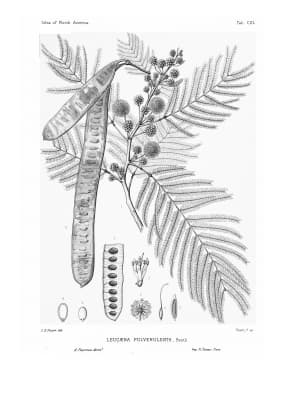
Leucaena pulverulenta
Leucaena pulverulenta
Safety & Hazards
None known
Cultivation Details
Leucaena pulverulenta is native from the semi-arid subtropical regions of southern Texas to the tropics of southern Mexico. It is known to experience occasional light to moderate frosts, though even occasional heavy frosts are known to damage and even kill it. It grows in areas of seasonal rainfall, with a mean annual rainfall in the range 700 - 1,000mm and a 5 - 6 month dry season[1]. Requires a sunny position, preferring fairly fertile, moist but well-drained soils. Usually found in the wild on shallow soils overlying limestone[1]. Leucaena pulverulenta shows weedy tendencies in parts of the native range, spreading and colonizing ruderal sites such as roadsides, abandoned fields and canal banks, sometimes fonning dense thickets, particularly in south Texas. It is therefore considered to pose significant risks of becoming a ruderal weed where introduced[1]. This species is moderately to highly susceptible to damage by psyllids[1]. The unripe seedpods are harvested by climbing the trees and lopping the terminal branches or groups of pods, often crudely, with machetes, small knives or cutting poles. Annual pollarding in this way apparently causes only limited damage to the trees which resprout and fruit annually[1]. This species has a symbiotic relationship with certain soil bacteria, these bacteria form nodules on the roots and fix atmospheric nitrogen. Some of this nitrogen is utilized by the growing plant but some can also be used by other plants growing nearby[2].
Propagation
Seed - it has a hard seedcoat and may benefit from scarification before sowing to speed up germination. This can usually be done by pouring a small amount of nearly boiling water on the seeds (being careful not to cook them!) and then soaking them for 12 - 24 hours in warm water. By this time they should have imbibed moisture and swollen - if they have not, then carefully make a nick in the seedcoat (being careful not to damage the embryo) and soak for a further 12 hours before sowing. Cuttings of semi-ripe wood. Cite as: Tropical Plants Database, Ken Fern. tropical.theferns.info. 2026-02-20. <tropical.theferns.info/viewtropical.php?id=Leucaena+pulverulenta>
Pollinators
Insects
References
- [1]Leucaena A Genetic Resources Handbook — Hughes C.E. · Oxford Forestry Institute; Oxford, UK · 1998 · https://herbaria.plants.ox.ac.uk/bol/leucaena/ · ISBN 0 85074 145 9 ↩︎An excellent guide to the genus, giving detailed information on the various species
- [2]World Agroforesty Centre — http://www.worldagroforestry.org/ ↩︎An excellent online database of a huge range of trees giving very good information on each plant - its uses, ecology, identity, propagation, pests etc.
- [3]Manual of the Trees of N. America. — Sargent. C. S. · Dover Publications Inc. New York. · 1965 · http://www.biodiversitylibrary.org/ · ISBN 0-486-20278-X ↩︎Two volumes, a comprehensive listing of N. American trees though a bit out of date now. Good details on habitats, some details on plant uses. Not really for the casual reader. It can be downloaded from the internet.
- [4]Plant Resources of Southeast Asia — http://proseanet.org/ ↩︎Lots of information on the uses of the plants of SE Asia.
- [5]Trees and Shrubs of Mexico — Standley P.C. · Smithsonian Institution; Washington · 1926 ↩︎Although dated, it contains a wealth of information on the trees and shrubs of Mexico, including many of their uses. It can be downloaded from the Internet.
- [6]IUCN Red List of Threatened Species — http://www.iucnredlist.org/ ↩︎A list of plants under threat and facing possible extinction, usually with brief details of the threats and information on habitat.
- [PFAF]Plants for a Future — pfaf.org ↩︎