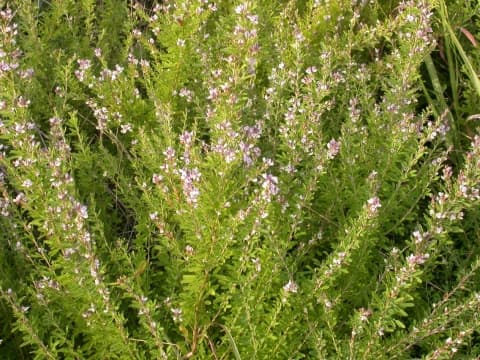
Lespedeza cuneata
Lespedeza cuneata
Safety & Hazards
None known
Cultivation Details
A plant mainly of the subtropics to the tropics, it can survive milder winters in temperate areas (although top growth is usually killed back to the ground) but is more generally grown as a summer annual in temperate areas[1, 2]. It can be found at elevations up to 2,400 metres in the tropics[2]. It grows best in areas where annual daytime temperatures are within the range 16 - 26°c, but can tolerate 6 - 36°c[2]. It prefers a mean annual rainfall in the range 1,000 - 1,400mm, but tolerates 650 - 2,350mm[2]. Easily grown in a well-drained, light to heavy loam in full sun[3, 2]. The roots can penetrate heavy clay subsoils[4]. It can grow in shallow soils, but grows best in deep soils, such as deep sands with organic matter or sandy loams with clay loam subsoil[5]. It will also grow on strongly acidic to neutral soils[5]. The plant is tolerant of poor, acid soils with high aluminium and low phosphorus levels[6]. Prefers a pH in the range 5.5 - 6.5, tolerating 4.5 - 7.1[2]. The plant produces cleistogamous flowers (closed flowers that produce fertile seed without being pollinated) as well as hermaphrodite flowes that are pollinated by insects, especially bees[7]. Seedlings are very slow to establish and generally require some weeding to reduce competition from other plants[6]. After the first year, plants compete very successfully with weeds[6]. When fertility of degraded soils has improved sufficiently, this species can be replaced by more productive crops. Eradication can be achieved by increasing the cutting intensity, followed by light disking and then sowing a fast-growing annual crop. The procedure often has to be repeated the following year[6]. In addition to the normally pollinated sexual flowers, this species also produces clusters of cleistogamous flowers in the leaf axils[7]. This species has a symbiotic relationship with certain soil bacteria, these bacteria form nodules on the roots and fix atmospheric nitrogen. Some of this nitrogen is utilized by the growing plant but some can also be used by other plants growing nearby[8].
Propagation
Pre-soak the seed for 24 hours in warm water and then sow it in spring in a greenhouse. When they are large enough to handle, prick the seedlings out into individual pots and grow them on in the greenhouse for at least their first winter. Plant them out into their permanent positions in late spring or early summer, after the last expected frosts. Cuttings of half-ripe wood, 7 - 10cm with a heel, mid summer in individual pots in a frame. It can be difficult to get the cuttings through their first winter, it is best to plunge the pots in a bed of ashes in a sheltered border outdoors[9]. Cite as: Temperate Plants Database, Ken Fern. temperate.theferns.info. 2026-02-21. <temperate.theferns.info/plant/Lespedeza+cuneata>
Pollinators
Bees, Insects, Cleistogamous
References
- [1]Ornamental Shrubs, Climbers and Bamboos. — Thomas. G. S. · Murray · 1992 · ISBN 0-7195-5043-2 ↩︎Contains a wide range of plants with a brief description, mainly of their ornamental value but also usually of cultivation details and varieties.
- [2]Ecocrop — http://ecocrop.fao.org/ecocrop/srv/en/home ↩︎Basic information on a wide range of useful plants, plus details of environmental needs where available.
- [3]RHS Dictionary of Plants plus Supplement. 1956 — F. Chittendon. · Oxford University Press · 1951 · ISBN - ↩︎Comprehensive listing of species and how to grow them. Somewhat outdated, it has been replaced in 1992 by a new dictionary (see [ 200 ]).
- [4]Fire Effects Information System — http://www.feis-crs.org/feis/ ↩︎An on-line information site with comprehensive information on over 1,100 species of plant. Mainly developed to supply information on the effects of fire on plants and animals, it also contains a wealth of other information on the plants
- [5]Global Invasive Species Database — http://www.issg.org/database/welcome/ ↩︎Very detailed information on almost 400 species (with more being added) of plants that have become weeds in areas outside their native range.
- [6]Plant Resources of Southeast Asia — http://proseanet.org/ ↩︎Lots of information on the uses of the plants of SE Asia.
- [7]Flora of China — Missouri Botanical Garden Press; St. Louis. · 1994 · http://flora.huh.harvard.edu/china/ ↩︎An excellent, comprehensive resource in 25 volumes. In addition to the botanical information the flora also gives basic information on habitat and some uses. An on-line version is also available.
- [8]The New RHS Dictionary of Gardening. 1992. — Huxley. A. · MacMillan Press · 1992 · ISBN 0-333-47494-5 ↩︎Excellent and very comprehensive, though it contains a number of silly mistakes. Readable yet also very detailed.
- [9]Propagation of Trees, Shrubs and Conifers. — Sheat. W. G. · MacMillan and Co · 1948 · ISBN - ↩︎A bit dated but a good book on propagation techniques with specific details for a wide range of plants.
- [10]Mansfeld's Database of Agricultural and Horticultural Plants — http://mansfeld.ipk-gatersleben.de/pls/htmldb_pgrc/f?p=185:3:4292127278597336 ↩︎Terse details of a huge range of useful plants.
- [11]IUCN Red List of Threatened Species — http://www.iucnredlist.org/ ↩︎A list of plants under threat and facing possible extinction, usually with brief details of the threats and information on habitat.
- [12]Flora of Japan. (English translation) — Ohwi. G. · Smithsonian Institution · 1965 · ISBN - ↩︎The standard work. Brilliant, but not for the casual reader.
- [13]Forest Flora of Srinagar. — Singh. Dr. G. and Kachroo. Prof. Dr. P. · Bishen Singh Mahendra Pal Singh · 1976 · ISBN - ↩︎A good flora of the western Himalayas but poorly illustrated. Some information on plant uses.
- [14]Tanaka's Cyclopedia of Edible Plants of the World. — Tanaka. T. & Nakao S. · Keigaku Publishing; Tokyo · 1976 · ISBN - ↩︎The most comprehensive list of edible plants I've come across. Only the briefest entry for each species, though, and some of the entries are more than a little dubious. Not for the casual reader.
- [15]Plants for Human Consumption. — Kunkel. G. · Koeltz Scientific Books · 1984 · ISBN 3874292169 ↩︎An excellent book for the dedicated. A comprehensive listing of Latin names with a brief list of edible parts.
- [16]Famine Foods listed in the Chiu-Huang Pen-ts'ao. — Reid. B. E. · Southern Materials Centre; Taipei · 1977 · ISBN - ↩︎A translation of an ancient Chinese book on edible wild foods. Fascinating.
- [17]A Barefoot Doctors Manual. — ? · Running Press; Philadelphica. · 1977 · ISBN 0-914294-92-X ↩︎A very readable herbal from China, combining some modern methods with traditional chinese methods.
- [18]CosIng — http://ec.europa.eu/growth/tools-databases/cosing/ ↩︎CosIng is the European Commission database for information on cosmetic substances and ingredients.