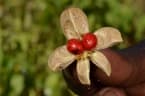
Cultivation Details
A plant of the moister, lowland tropics up to elevations of 1,100 metres. It is found in regions with more than 1,600 mm annual rainfall and attains its highest density in regions with 2,000 mm annual rainfall[1]. Prefers a well-drained soil, tolerating infertile soils[1]. The tree is classified as a shade-bearer[1]. Seedlings are most common in the shade, although they are occasionally found in full sunlight. They are often even common in deep shade, where they can survive for a long time[1]. All sizes of seedlings and saplings are less abundant in forest affected by recent logging, in comparison with undisturbed, not too dense forest[1]. However, for further development, some opening of the forest canopy seems essential[1]. Initial growth of seedlings is slow, less than 30 cm after 1 year[1]. They show their best growth at 10% of full sunlight. If they are exposed to more sunlight after 1 year, growth may speed up, reaching annual growth rates of up to 1 metre in height in plots managed by the tropical shelterwood system[1]. In Guinea trees planted in the understorey showed a mortality of about 50% and reached a mean height of 2.5 - 3 metres at 6 years of age, for those planted in forest paths the mortality was 25 - 30% but the height only 1.2 metres, and all seedlings planted in full sun died within 2 years[1]. It is recommended to start thinning the upper storey of the forest 4 years after planting so that the saplings receive progressively more light[1]. Planted trees in Ghana reached a height of up to 15 metres and 19 cm in bole diameter in 14 years. Under natural conditions in Cote d'Ivoire an average annual diameter increment of 2.9 mm was recorded, and in Ghana it was 3.2 - 5.5 mm. In Nigeria it has been estimated that it takes more than 170 years for the trees to reach 100 cm in bole diameter[1]. Trees can flower and produce fruit twice a year, or even all year round in some areas. The ripe fruits often develop at the beginning of the dry season[1, 2]. A dioecious species, both male and female forms need to be grown if fruit and seed are required[2].
Propagation
Seed - pre-soaking in cold water for 12 hours prior to sowing has been recommended to speed up germination[1]. Fresh seeds have a fairly high water content, about 27%. They have a short viability, but can be stored in sealed containers for at least 2 weeks[1]. It is recommended to add ash to reduce damage by insects[1]. Germination is irregular and often rather slow, usually taking 20 - 45 days, but sometimes as much as 65 days[1]. Seed beds in the nursery should be shaded[1]. Seedlings are drought sensitive[1]. The tree has comparatively large seeds, with a 1000-seed weight of 1 - 3.5 kg[1]. Cite as: Tropical Plants Database, Ken Fern. tropical.theferns.info. 2026-02-20. <tropical.theferns.info/viewtropical.php?id=Leplaea+cedrata>
Pollinators
Data unavailable
References
- [1]Protabase - Plant Resources of Tropical Africa. — http://www.prota.org ↩︎An excellent on-line database with detailed information on over 3,200 species of useful plants of Africa.
- [2]A taxonomic revision of the reinstated genus Leplaea and the newly recognized genus Neoguarea — Koenen E.J.M.; de Wilde J.J.F.E. · The Royal Botanical Society; Belgium. · 2012 · http://dx.doi.org/10.5091/plecevo.2012.656 · ISBN 2032-3913 ↩︎A review of the genus Guarea in Africa, it excludes all the African species from that genus, placing the majority of them in Leplaea and one in Neoguarea. It can be downloaded from the Internet.
- [3]The Useful Plants of West Tropical Africa. — Burkil. H. M. · Royal Botanic Gardens; Kew. · 1985 - 2004 ↩︎Brief descriptions and details of the uses of over 4,000 plants. A superb, if terse, resource, it is also available electronically on the Web - see http://www.aluka.org/